Author: Otto Schlichtherle

  • Business Process Management – Part I

    Summary

    Organizational units are parts of a company that focus on specific activities, resources, or goals. They are often linked to cost centers and can be visualized in an organizational chart. While business functions describe what an organizational unit does, processes offer a “horizontal” view of interrelated activities to achieve objectives across functions.

    Historically, companies were structured hierarchically, with each department working independently. However, this often led to inefficiencies, as improvements in one department could negatively affect others. Michael Porter’s concept of “competitive advantage” (1985) emphasizes that companies gain an edge by offering more value to customers, with key competitive factors being cost, time, quality, and service.

    Business process management shifts the focus from optimizing departments to optimizing processes that span multiple departments. It also focuses on the customer’s perspective, asking how a company can gain a competitive advantage by improving business processes.

    There is a difference between products and services. Services are intangible, perishable, and must be produced and consumed simultaneously, whereas products can be stocked. Business processes deliver products or services.

    A process specification is composed of tasks, activities, roles, business functions, and other components which are described in this article.


    Introduction


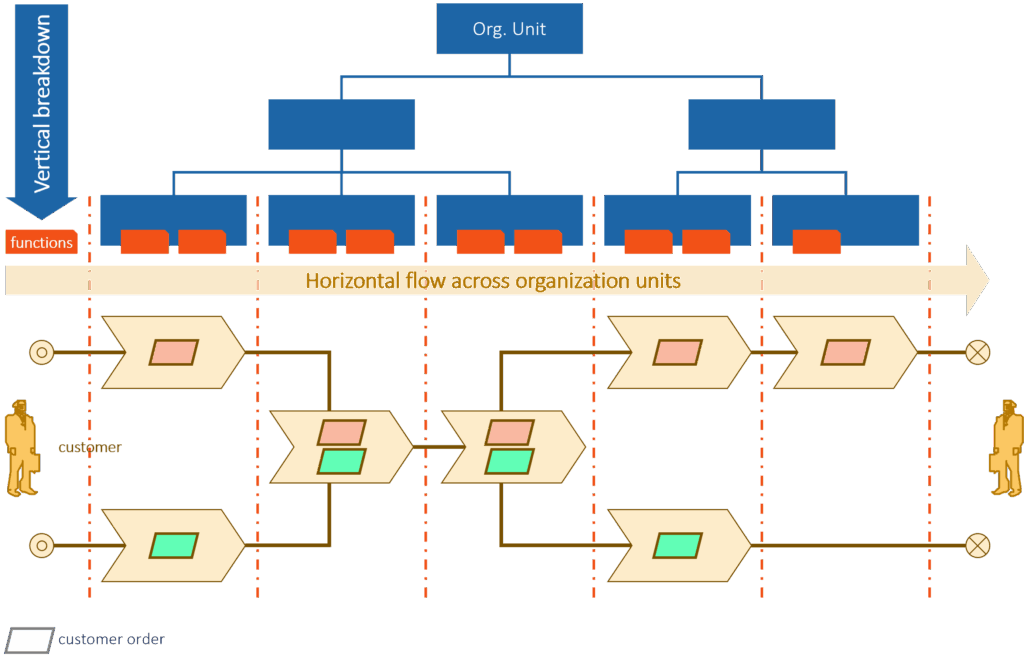
    Organization units are a foundational concept to organize work. An organizational unit is a distinct part of an organization that is responsible for specific activities, resources, or objectives. It specifies how work and people are grouped within the overall structure of the company.

    Organization units are often related to cost centers. The vertical break down of an organization into organization units can by visualized by an organization chart.

    Business functions describe what an organization unit does, the major capabilities / purposes that support its goals. In contrast, an organizational unit shows who does it and where it sits in the hierarchy.

    Processes describe a “horizontal” view. A business process is seen as a series of interrelated steps or activities carried out to achieve a specific outcome or objective within or across functions / organization units.

    The figure on the below shows schematically the flow of a customer order through an organization.


    Let’s have a look to the following Order-2-Cash scenario:
    A company sells products to customers. The “order-to-cash” process covers everything from receiving an order to collecting payment.
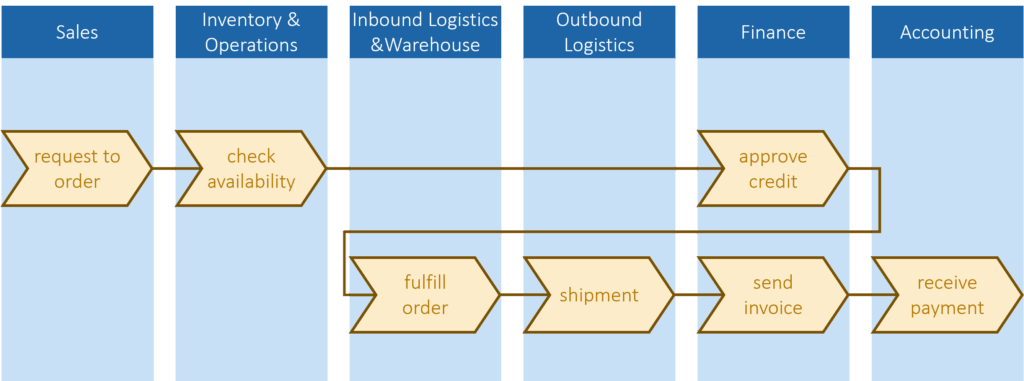


    A simplified version of the order to cash process could look like the following:

    • The sales department handles the ordering process.
    • The operations checks whether the ordered products are available.
    • The finance department verifies the customer’s credit before confirming the order.
    • The Inbound Logistics &Warehouse department picks the requested products.
    • The outbound logistics department conducts the shipment.
    • The finance department creates and sends out the invoice.
    • The accounting department tracks and books the payment.

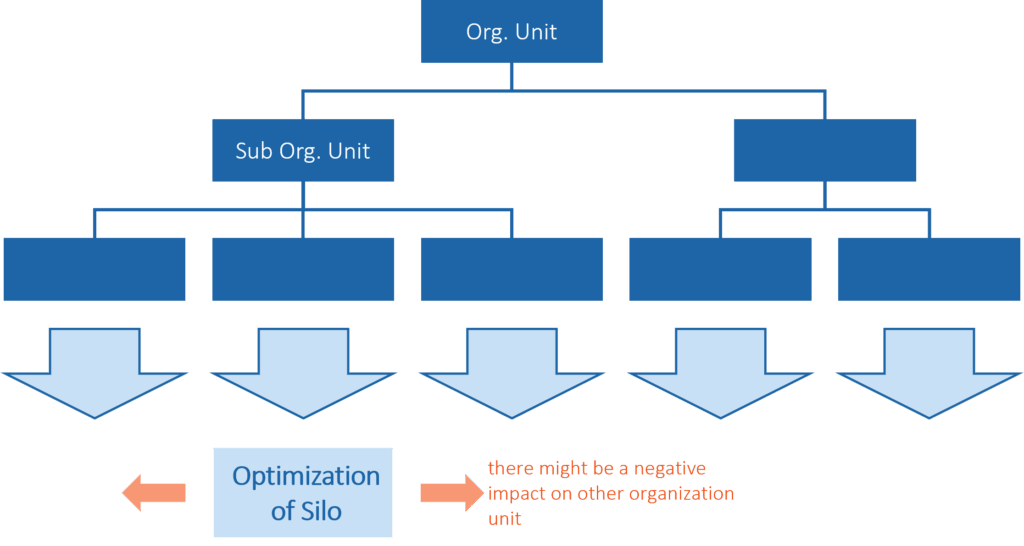
    Company structures are often organized in a hierarchy, based on the idea of dividing tasks (applying the principle “division of labor”).

    In the past, each department had to operate as independently as possible because sharing information was slow and expensive (like using paper forms or carbon copies).

    Each department worked to improve things like efficiency, effectiveness, or quality.


    Michael E. Porter defined in 1985 “competitive advantage” as the ability of a company to outperform its competitors by delivering greater value to customers. From the customer’s point of view, competitive advantage essentially means that the company provides something that makes it more attractive or valuable than other options in the market.

    Most relevant competitive factors are cost, time, quality, and service.

    Business process management changes the perspective from the organization unit to the customer. The question is no longer “how can I optimize my organization?”. From a customer point of view we have to ask the question “How can we get a competitive advantage?”. To answer this question we have a look at the business processes which are crossing organization units.
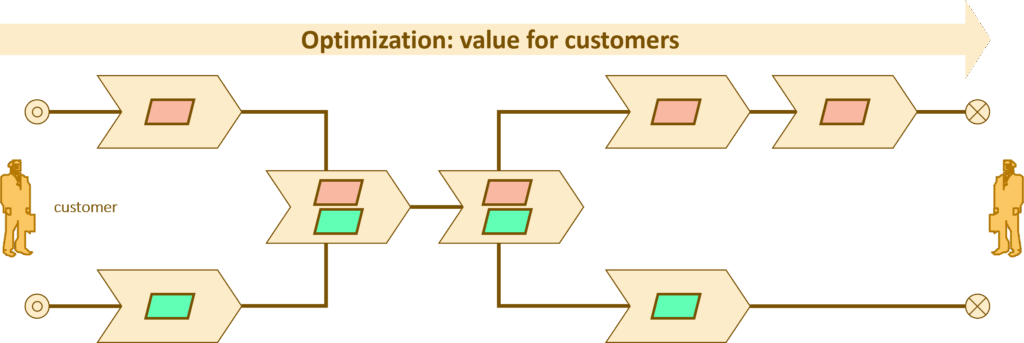


    The competitive factors are:

    • Price (cost)
    • Speed (delivery time, adherence to deadlines)
    • Quality Service
    • Convenience
    • Personalization
    • Customer Experience
    • Trust
    • Sustainability
    • Loyalty
    • Flexibility, time to market

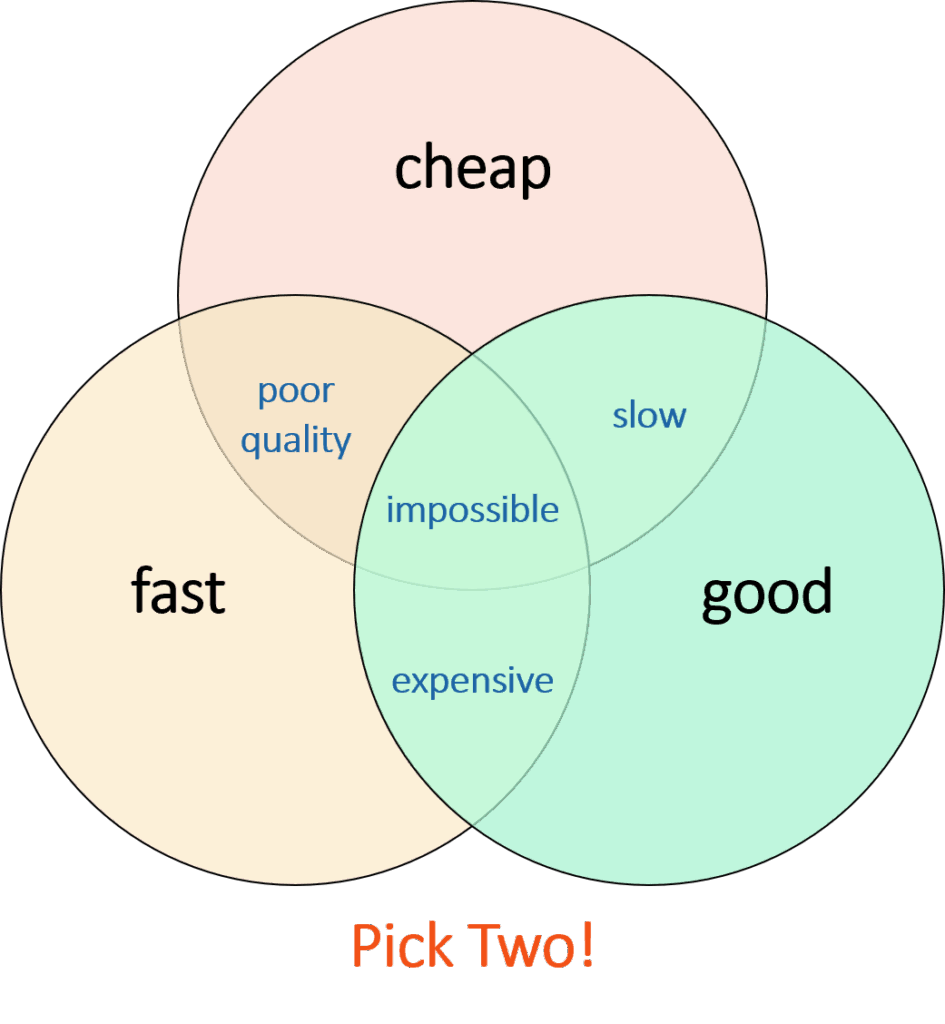
    The saying “Good, Fast, Cheap: Pick Two“ refers to the competitive factors price, quality, and time. It means you can’t have all three choices at once.

    If you need something good and fast, it won’t be cheap.

    If you need it good and cheap, it won’t be fast.

    If you need it fast and cheap, it won’t be good.

    This is often called the “Iron Triangle” or “Triple Constraint”.


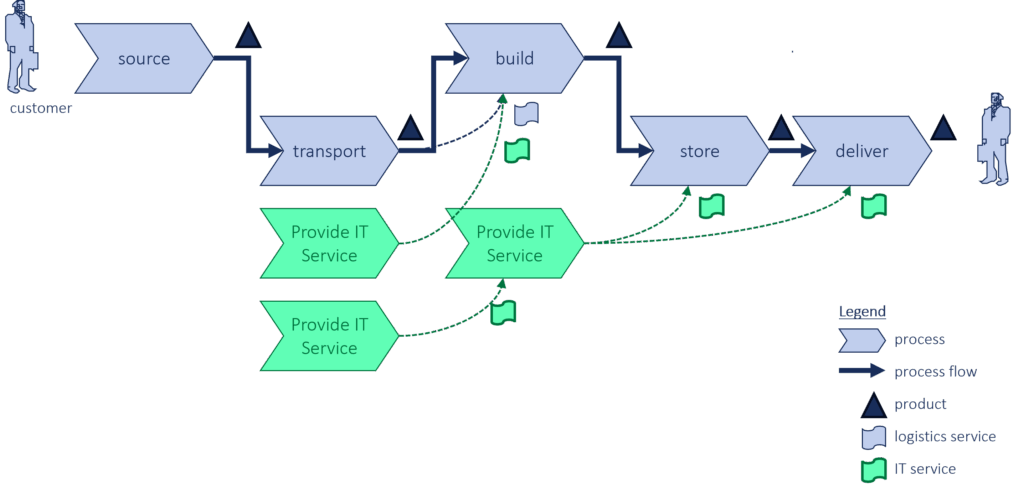
    A service is a means to deliver value to customers by facilitating outcomes customers want to achieve without the ownership of specific costs and risks.

    In contrast to services, products can be produced on stock.

    Services are perishable, intangible, and inseparable, they must be produced and consumed simultaneously. A service is the intangible equivalent of an economic good.

    Services are provided by business processes and consumed by other business processes.

    A logistics service provider offers logistics services to. An IT service provider offers services related to information technology, e. g. the hosting and operation of a transport control application.

    The logistics service provider supports the business processes of customers with logistics services and enhances core logistics services with IT services.


    Composition Of A Business Process Specification

    Tasks describe the steps or actions taken to perform a specific piece of work.

    Tasks represent the lowest level of granularity. There is no further break down of tasks.

    Tasks describe the performed work. Different parties may describe performed work in different ways. Normally multiple “correct” descriptions of performed work exist. “Good” descriptions can be differed from “bad” descriptions.

    Tasks may be performed manually, may have automated support, or may be totally automated.

    The picture below schematically shows a sequence of tasks.



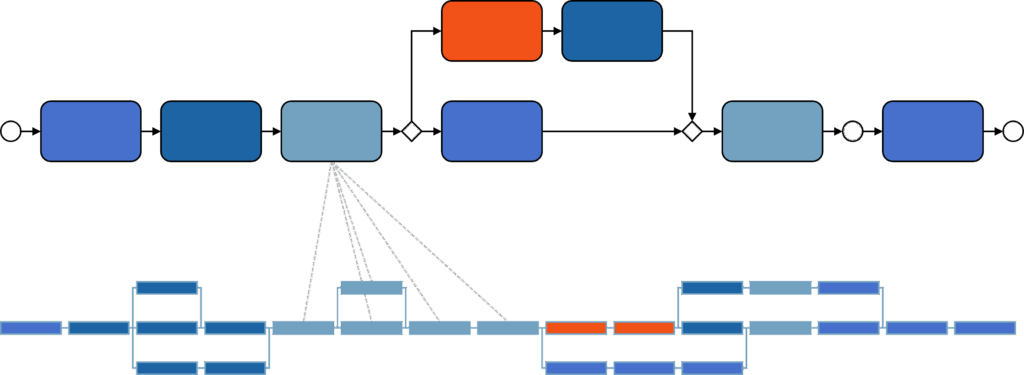
    Tasks can be aggregated to activities.

    Different parties may aggregate tasks to activities  in different ways to describe performed work.

    Multiple “correct” aggregation of tasks may exist! Activities are more abstract. They “hide” details provided by a description on task level.


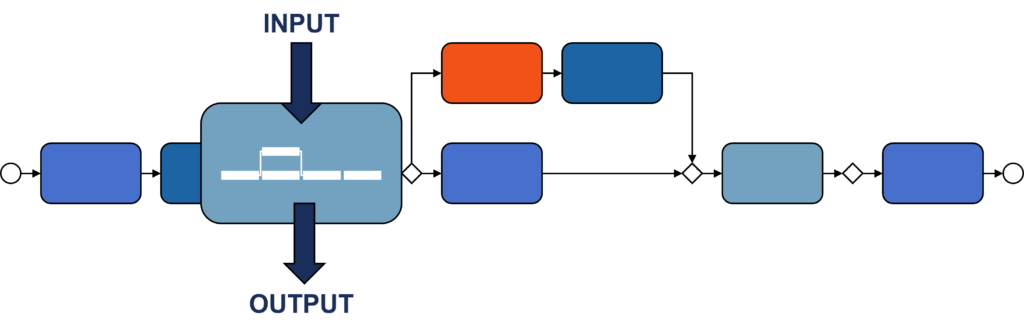
    In contrast to tasks, activities normally consume an input to deliver an output.


    The tasks of an activity are executed by persons.

    Each person has certain responsibilities and a required set of skills and competences to fulfill the tasks.

    Responsibilities, skills and competences are described by roles. Roles establish a link between persons and activities.
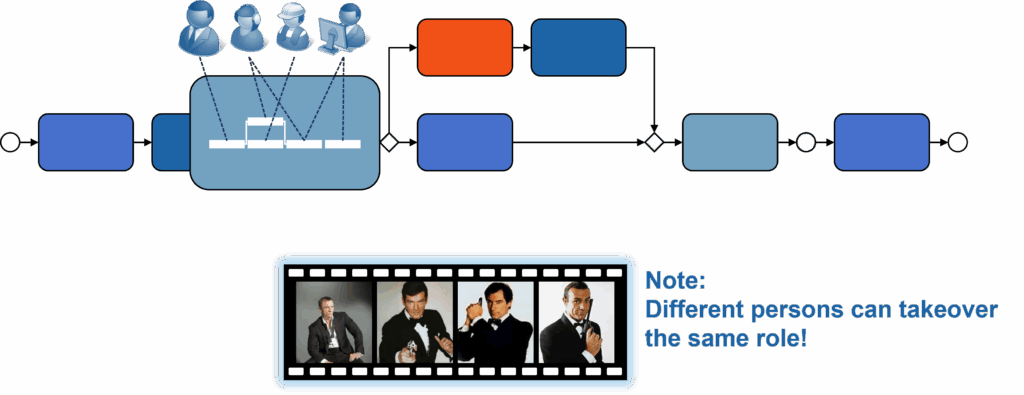


    A sequence of activities that transform one or more inputs into a specific output can be aggregated to a process.
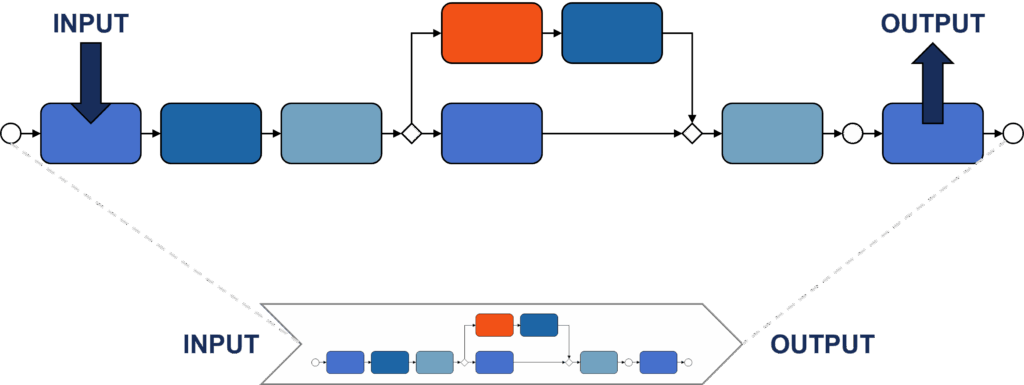


    Like tasks and activities, different parties may aggregate activities to processes  in different ways to describe performed work.


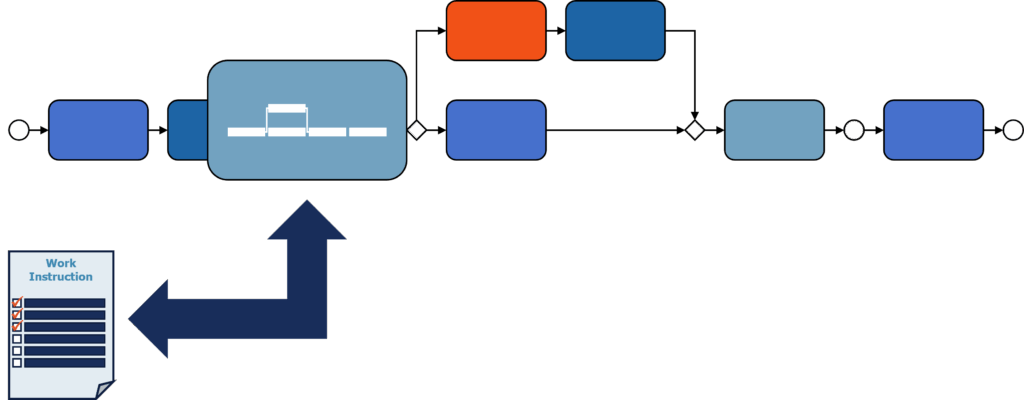
    A work instruction describes how an activity is performed. A work instruction can encompass a sequence flow of the tasks to be executed or any technical information required for understanding.


    A RACI matrix (also called a Responsibility Assignment Matrix) is a simple method to clarify roles and responsibilities for tasks applied in a business process.

    The matrix shows in the rows the activities and in the columns the roles. For each task / role the one of the letters R, A, C I is assigned..
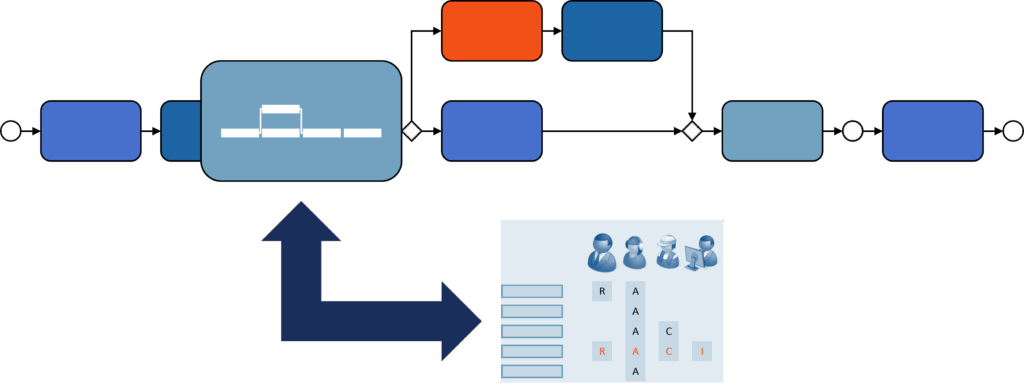


    A – The person who is ultimately answerable for the correct completion of the task. They approve the work and ensure it meets requirements. Each task should have only one Accountable person.

    C – People who provide input, expertise, or feedback before the work is done. These are usually subject matter experts.

    I – People who are kept up to date on progress or decisions but are not directly involved in the task.

    R – The person(s) who actually do the work to complete the task. They are responsible for action and implementation.


    The workflow or sequence flow represents the sequence in which different events, activities, and further elements are traversed.

    When a process is carried out, it uses/creates input/output like data, information, files, documents, etc. A sequence flow from one activity to another is often accompanied by data flow.
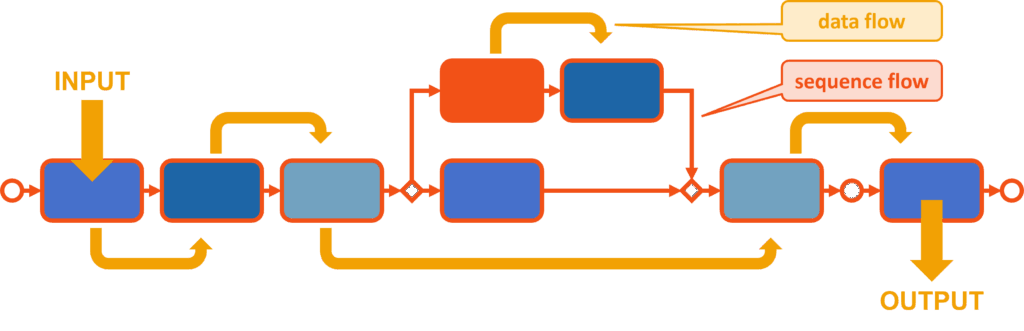


    Sequence flow and data flow are two different flows. Don‘t mix them up! It is not possible that a sequence flow becomes a data flow, or a data flow becomes a sequence flow.


    The division of labor is the separation of tasks in any economic system so that participants may specialize. Individuals, organizations, and nations are endowed with or acquire specialized capabilities and either form combinations or trade to take advantage of the capabilities of others in addition to their own.”

    (taken from https://en.wikipedia.org/wiki/Division_of_labour, November 2016)

    Activities can be grouped by applying the principle of „division of labor“.

    Groups represent business functions which can be mapped to organizational units.

    Ideally a business function is provided by one organizational units, but in practice we see also multiple organizational units providing the same business function.
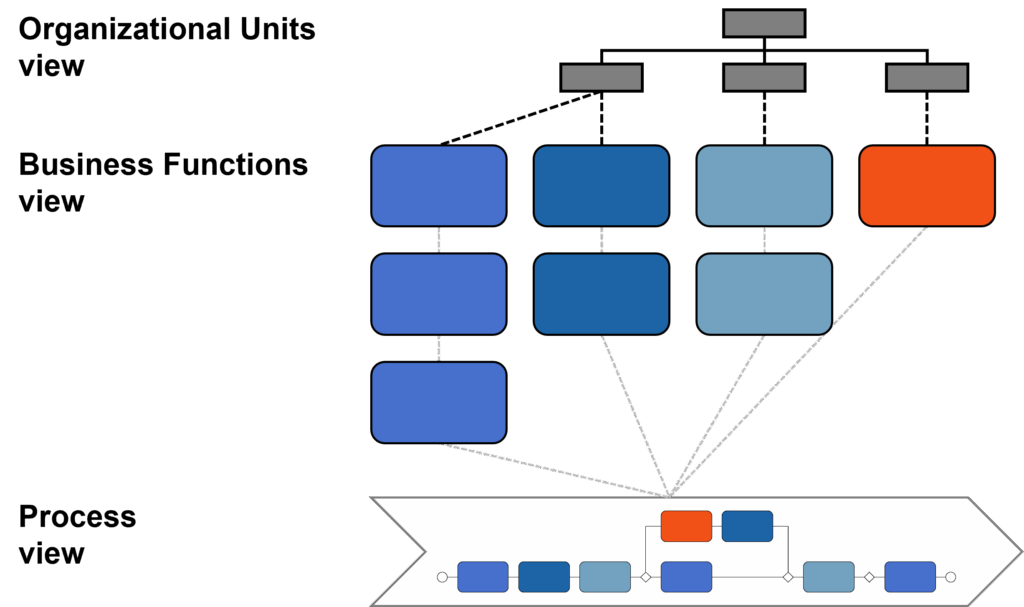


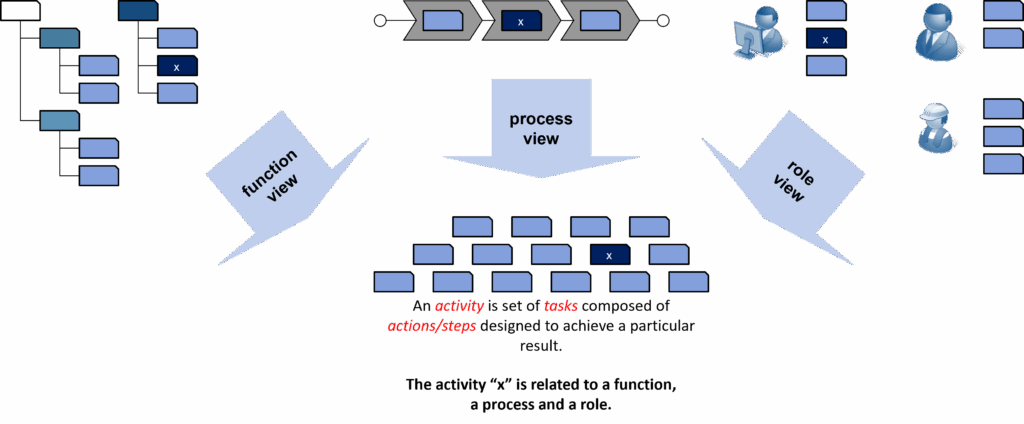
    The diagram below illustrates the different views on activities.

    • A function is a team or group of people and the tools they use to carry out one or more processes or activities.
    • A process is a structured set of activities designed to accomplish a specific objective. A process takes one or more defined inputs and turns them into defined outputs.
    • A role is a set of responsibilities, activities and authorities granted to a person or team.

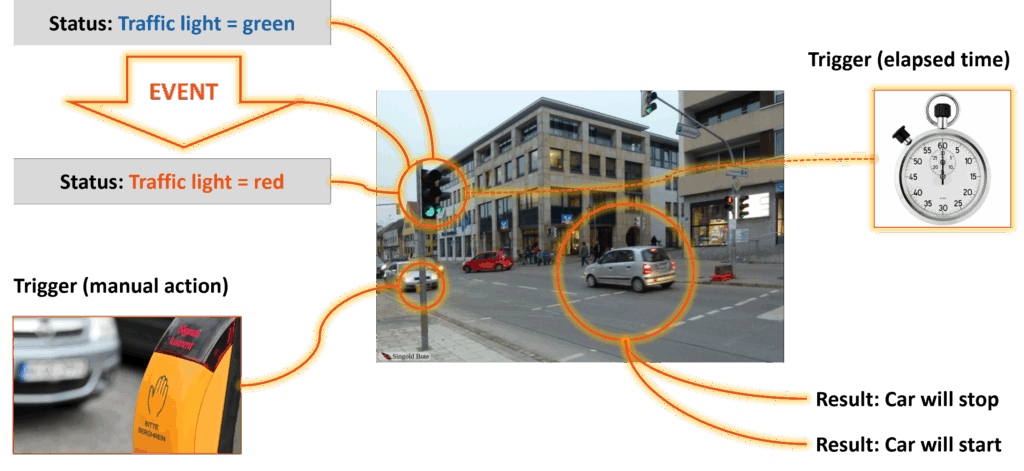
    A state captures relevant aspects of a a process. It represents the status of an object. E. g. the status of a traffic light could be red, amber, green.

    An event occurs at a particular instant in time and marks a change of. In the traffic light example an event occurs when the status of a traffic light changes from green to amber.

    For a fire arm, the trigger is a mechanism that actuates the firing sequence.

    In a more common context a trigger may also start another.

    In our traffic light example the event “traffic light changed” can be triggered by pushing a button or, time driven by a clock, when a certain amount of time is elapsed.

    The result is the consequence of an event.

    Trigger and start/finish events will be specified in a process description.


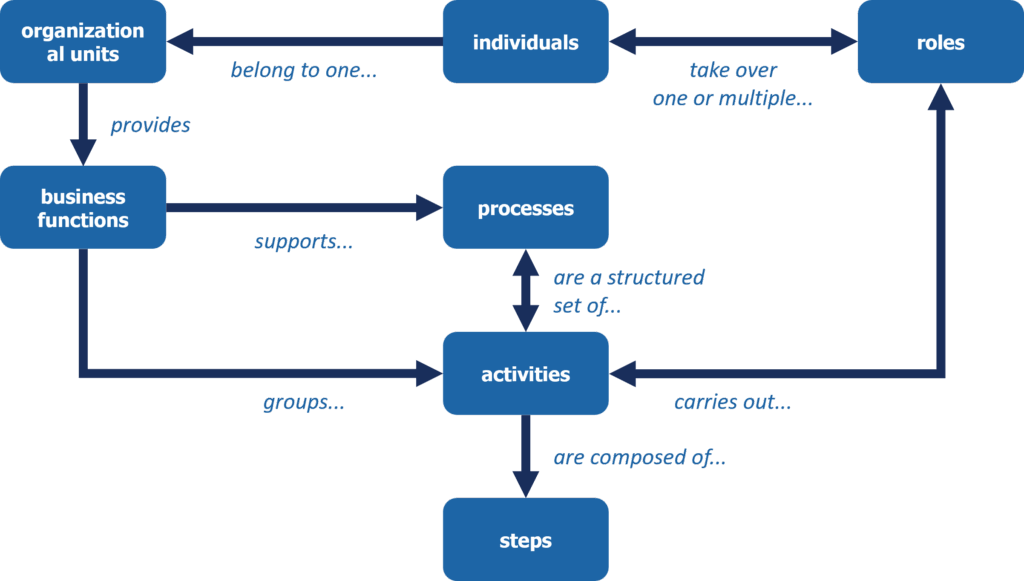
    The entity relationship diagram below shows, how the different elements of a business process descriptions belong together.


    A state captures relevant aspects of a a process. It represents the status of an object. E. g. the status of a traffic light could be red, amber, green.

    An event occurs at a particular instant in time and marks a change of. In the traffic light example an event occurs when the status of a traffic light changes from green to amber.

    For a fire arm, the trigger is a mechanism that actuates the firing sequence.

    In a more common context a trigger may also start another.

    In our traffic light example the event “traffic light changed” can be triggered by pushing a button or, time driven by a clock, when a certain amount of time is elapsed.

    The result is the consequence of an event.

    Trigger and start/finish events will be specified in a process description.


    A process is more than a structured set of activities. A process specification encompasses, beside a workflow diagram, other elements.

    The following figure illustrates the composition of a business process specification:
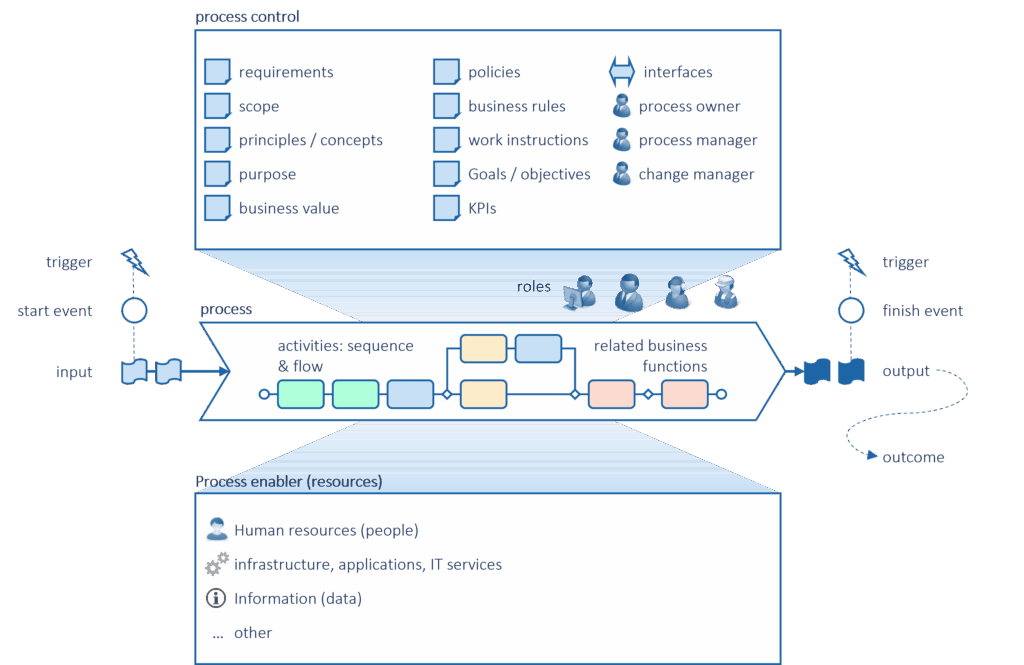


    The requirements specification describes the conditions that must be met for the process to function properly — essentially, what the process must be able to do:

    • Functional requirements: what the process or system should do (e.g., “automatically send confirmation emails to customers”).
    • Non-functional requirements: quality or performance criteria (e.g., “confirmation emails must be sent within 5 minutes”).
    • Regulatory or compliance requirements, if applicable.
    • Data or resource requirements, such as what information or tools are needed.

    The scope statement is a description of the boundaries of the process — what is included and what is excluded:

    • The start and end points of the process.
    • The key activities, inputs, and outputs.
    • The departments, systems, or roles involved.
    • Any limitations, exclusions, or interfaces with other processes.

    The principles & concepts document the general ideas behind the business process.


    The purpose specification is a clear statement explaining why this process exists and what it aims to achieve.

    • The reason for developing or improving the process.
    • The main objectives or goals (e.g., efficiency, compliance, customer satisfaction).
    • How it aligns with the organization’s strategy or vision.
    • Who benefits from the process (e.g., departments, customers, partners).

    The business value description points out the benefits or value the process delivers to the business — the “why it matters”:

    • Tangible benefits (e.g., cost savings, faster processing time, error reduction).
    • Intangible benefits (e.g., better customer satisfaction, improved compliance, stronger reputation).
    • Key performance indicators (KPIs) or metrics to measure success.
    • Expected ROI or strategic impact.

    Policies, business rules, and work instructions are key parts of a business process specification. They each describe a different level of detail and control within a process.

    Policies are high-level principles or guidelines that set the direction or framework for decision-making within the process. Policies are typically broad and stable — they tell you what must or must not be done and why, but not how.

    Business rules are specific. They describe detailed conditions or constraints that govern how the process operates within the policy framework. Business rules translate policies into actionable logic that can be applied or automated.

    Work instructions specify step-by-step procedures or instructions that describe exactly how to perform a task within the process. They are the most detailed level — meant for the people actually performing the work.

    The business process interface specification defines the relationships to other business processes. Output of one process could be input of another process.

    The roles process owner, process manager, and change manager are key governance roles in a business process specification. Each has distinct responsibilities and a specific relationship to the process.

    The process owner is the strategic leader of the process. He is accountable for its overall design, performance, and alignment with business goals. Any changes to the process specification, design, and implementation are supervised by the process owner.

    The process manager is the operational leader responsible for the day-to-day management and continuous improvement of the process. While the process owner defines what the process should achieve, the process manager ensures how it runs smoothly.

    The change manager has a governance and transition role. He is responsible for managing changes to the process — ensuring they are assessed, approved, implemented, and communicated in a controlled way.
  • IT Project Portfolio Meets IT Service Portfolio

    Summary

    This article outlines the distinctions and interrelationships between IT operations, IT service management, and IT project management.

    While IT operations are ongoing and repetitive, projects are temporary and unique.

    IT Service Management (ITSM) operates as a strategic layer over IT operations, often divided into technical operations and user-facing services, and includes functions like Service Catalogue Management.

    Service Portfolio Management aligns IT services with strategic objectives, like Project Portfolio Management, by evaluating benefits, risks, budgets, and resource requirements.

    The traditional Plan–Build–Run paradigm separates project execution from service operations but struggles in complex, agile environments.

    Alternatively, the Demand–Supply–Execute paradigm integrates project and service management, recognizing shared resources and the need for adaptive execution. The text emphasizes the blurred lines between incidents, service requests, and projects, noting that both services and projects rely heavily on human resources (80% of spend) and increasingly overlap in execution.

    The overall message advocates for integrated, flexible approaches to IT delivery, resource allocation, and value creation.

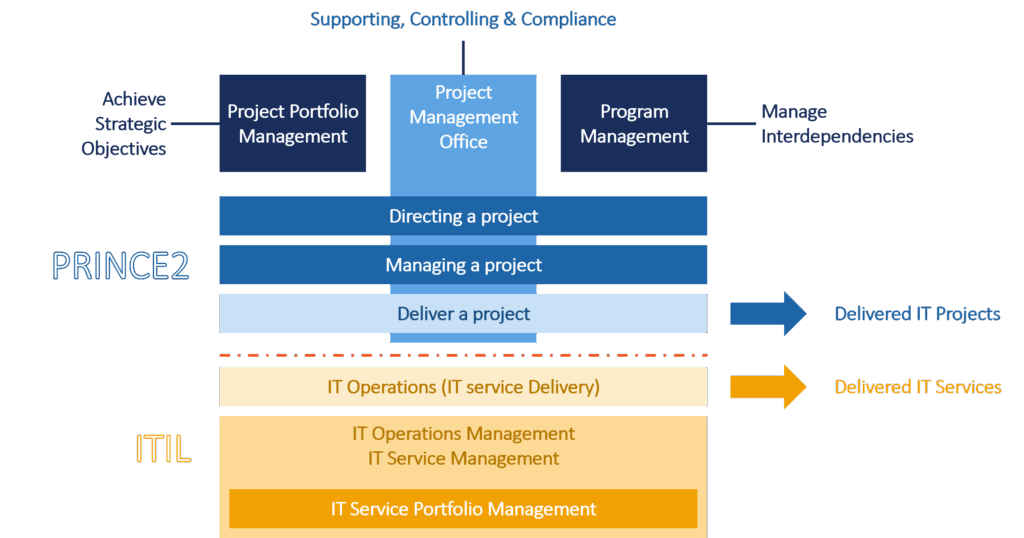
    IT Project- & IT Service Management Map

    IT Service Delivery  / IT Operations

    In contrast to projects, IT operations are ongoing and repetitive (like running a factory or providing customer service).

    Projects (which are a one-time endeavor) and operations (which are repeatable) can be considered as two different domains.

    IT Service management

    This is the management layer above the IT operations. Some company split it into technically focused operation management and customer/user orientated service management. IT Service Management includes IT Service Catalogue Management.

    IT Service Portfolio Management

    The Service Portfolio Management could be seen as a pendant to the Project Portfolio Management. According to the strategic objectives the offered IT services are selected.

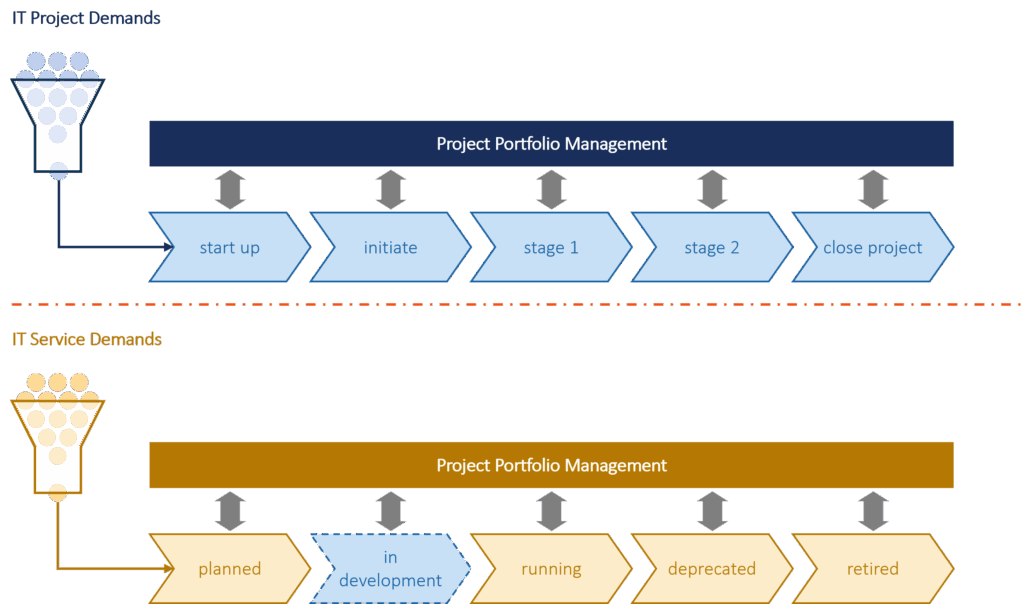
    IT Project Portfolio Meets IT Service Portfolio

    The management and an IT project and an IT service portfolio is very similar.

    Both deal with portfolio items and decide based on the organization’s strategy which items should be moved to the next stage.

    The criteria are, among others

    • Expected benefit (monetary & nonmonetary)
    • Budget requirements / availability
    • Resource requirements / availability
    • Risks (threads & opportunities)
    • Expected availability date

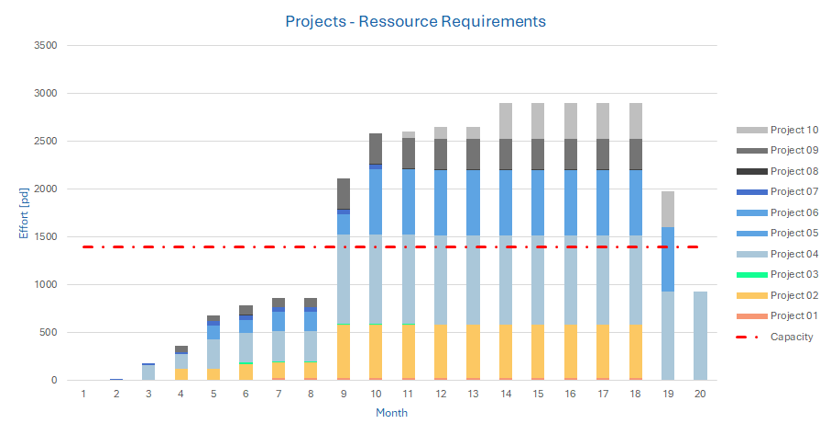
    Resource Constraints Are Impacting Services & Projects

    An example of the resource requirements of projects and service delivery is shown above. The orange bars show the resources assigned to service delivery (keep the lights on). The bars above the blue dotted line shows the resource requirements of project.

    In month 9 the total required resources exceeds the resource capacity limit.

    Resource conflicts lead to

    • Overburden & multitasking
    • Poor quality
    • Significant delays in project delivery
    • Breaches of service level agreements

    Plan Build Run Vs. Demand Supply Execute

    It’s all just work

    Incident / Service Request) Tickets become projects and projects become tickets.
    A project could impact application- & infrastructure services.
    Services could be seen as open ended “projects” for time being.
    Services require provisioning which could be handled as a project.
    Services and projects compete against the same resources!
    Projects deliver output, services transform output into outcome which is visible as delivered IT value.
    Distinction between incidents, problems, changes, and user stories become increasingly arbitrary when it is the same team that needs to respond to any.
    80% of spend is people.

    Plan Build Run

    The Plan–Build–Run paradigm separates the world of “projects” (plan & build) from the world of “services” (run). It encourages waterfall thinking. Results in systems are built in isolation from one another. Plan build run works fine for a single system but encounters difficulties in complex service environments with overlapping service-, application-, technology-, and asset life cycles. It is difficult to cope with ongoing improvement, accelerating delivery cycles, agile service delivery processes.

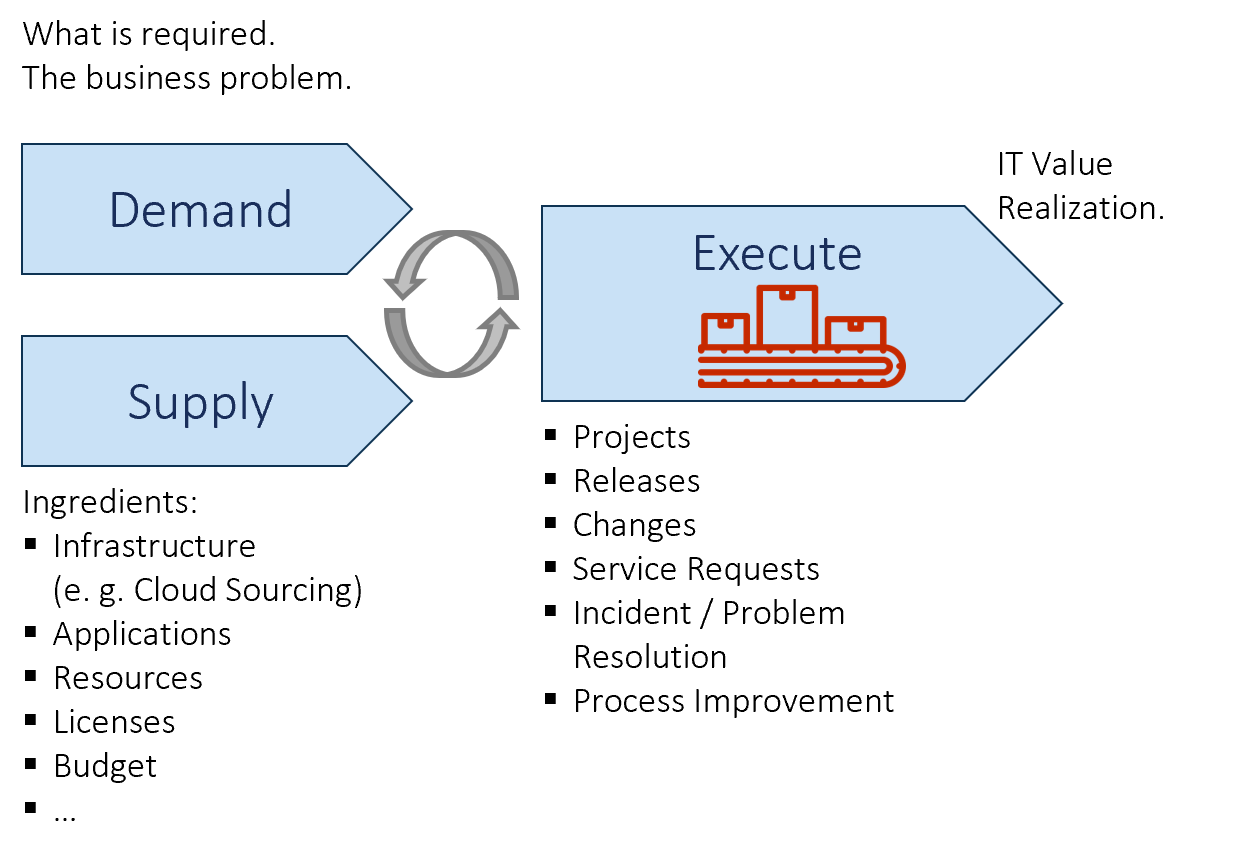
    Demand Supply Execute

    The Demand–Supply–Execute paradigm reconciliates the IT project portfolio items with the IT service portfolio items, both compete for the same resources. It sees time and resource management as a critical success factor. The execute stage supports multiple projects as well as multiple dynamically evolving services.

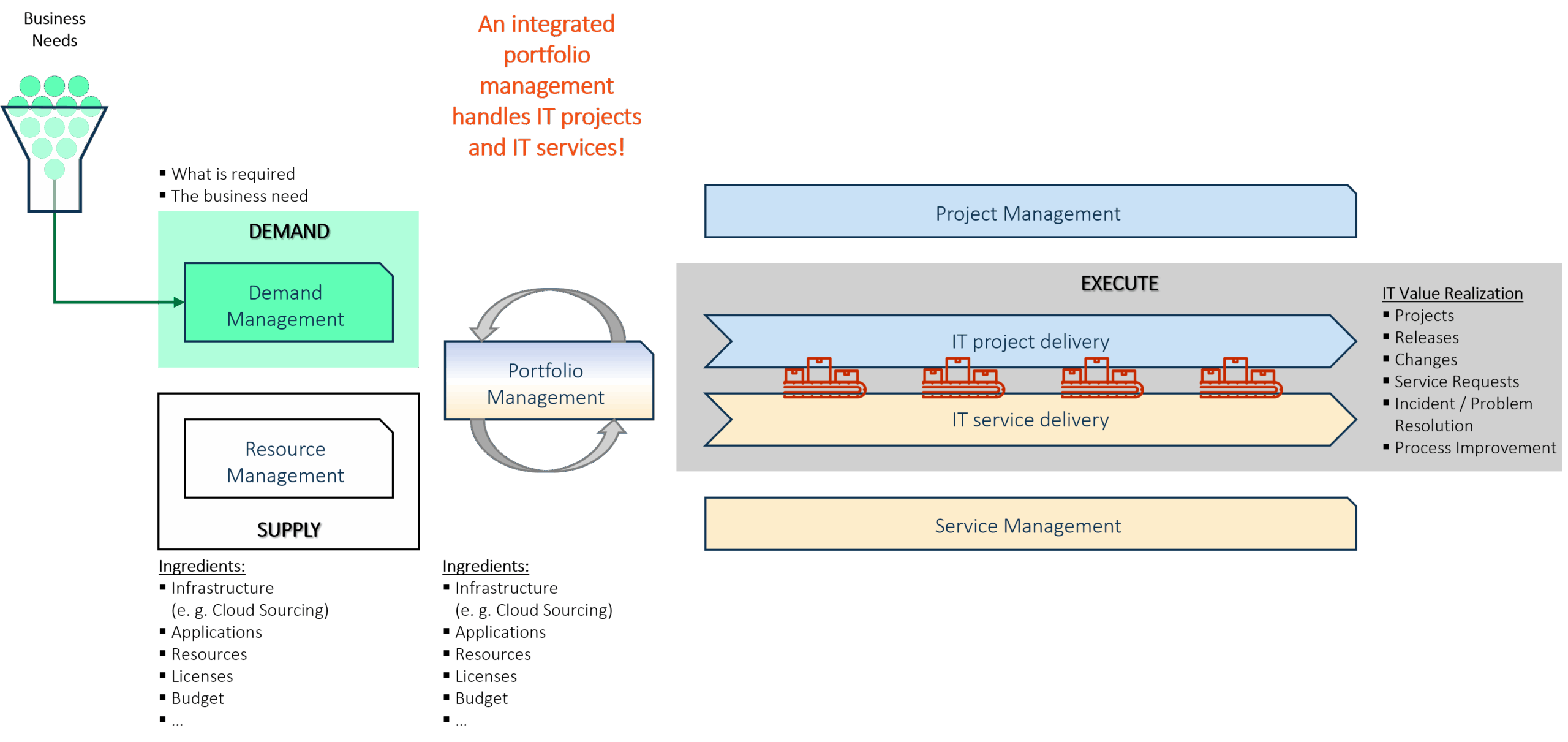
    IT Portfolio Management Based On The Demand Supply Paradigm

    The following figure visualizes the concept of an integrated IT portfolio management. Incoming demands are evaluated and will be shifted to execution if they can be “married” with the required supply items (resources, …). IT portfolio management selects valuable items based on known criteria.

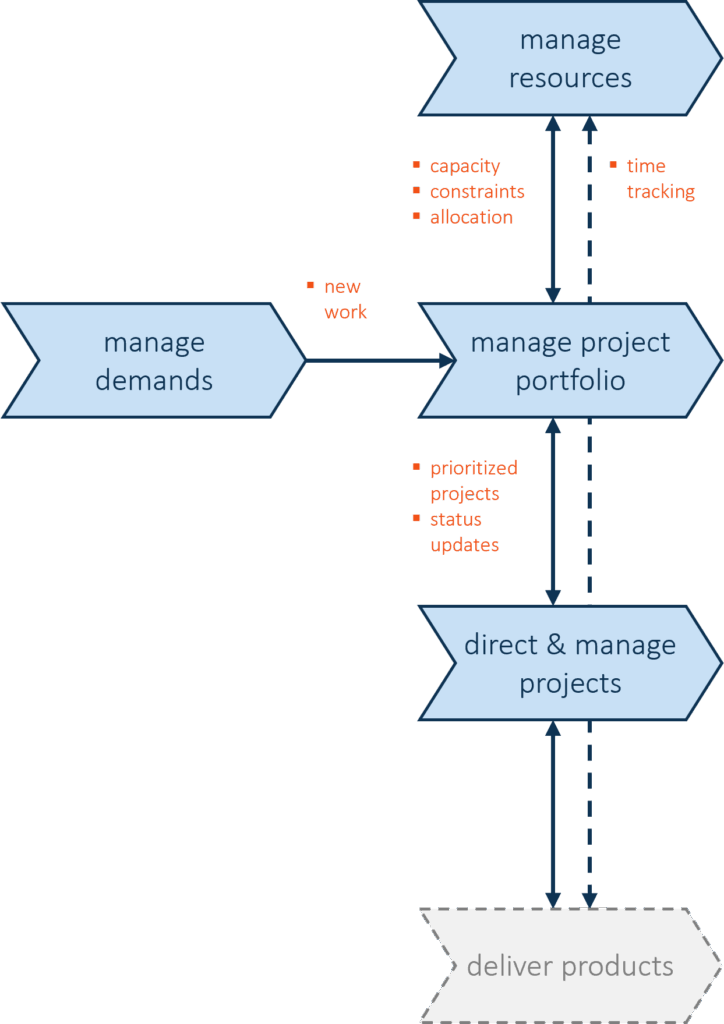
  • Setup Project Portfolio Management

    Summary

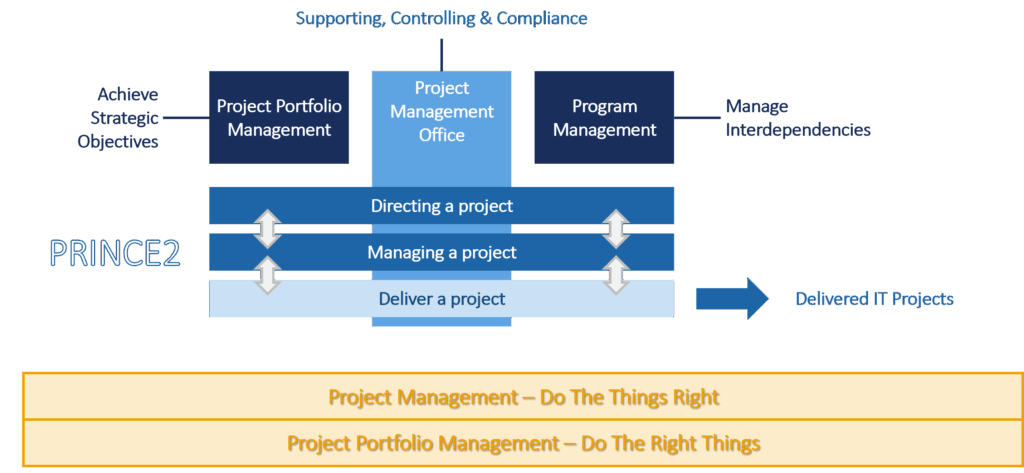
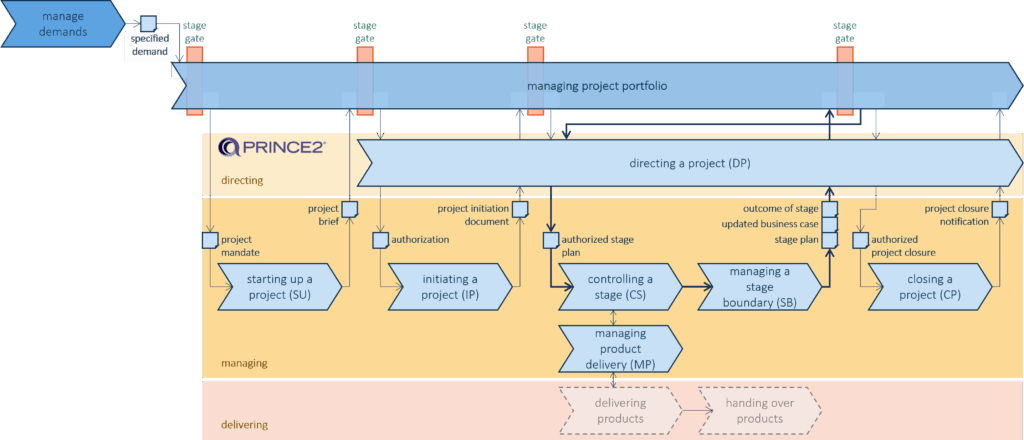
    Project Portfolio Management Vs. Project Management

    • Directing a project
      The Project Board provides overall direction and decision-making throughout the project.
    • Managing a project
      The Project Manager runs the day-to-day management of the project.
    • Delivering a project
      This is the actual creation of deliverables under the direction of the Project Manager
    • Project Portfolio Management
      Project portfolio management is the strategic management of a group of projects and programs (owned by an organization) to ensure they collectively achieve an organization’s objectives, optimize resource use, and balance risks and returns.
    • Project Management Office
      The project management office is a supporting function for project management.
    • Program Management
      Program management is the coordinated management of multiple related projects (dependencies), aligned to achieve strategic objectives and deliver benefits that wouldn’t be realized if the projects were conducted separately.
    • Resource and budget limitations mean we cannot execute all proposed projects.
      We must place our limited amount of chips on the right squares!
    • Trade-offs are necessary.
    • Some projects support different or even opposing strategic goals.
    • Alignment with overall business priorities is key.
    • Certain projects are critical and must be delivered to ensure business continuity.
    • Others are less urgent or can be postponed
    • Each project’s expected value should be weighed against its
    • Risks (threats and opportunities)
    • Required resources
    • Duration
    • Budget impact
    • We must accept that we can’t satisfy every demand.
    • Our limited resources must be allocated where they create the most impact.

    Process Context

    Functions / Purpose

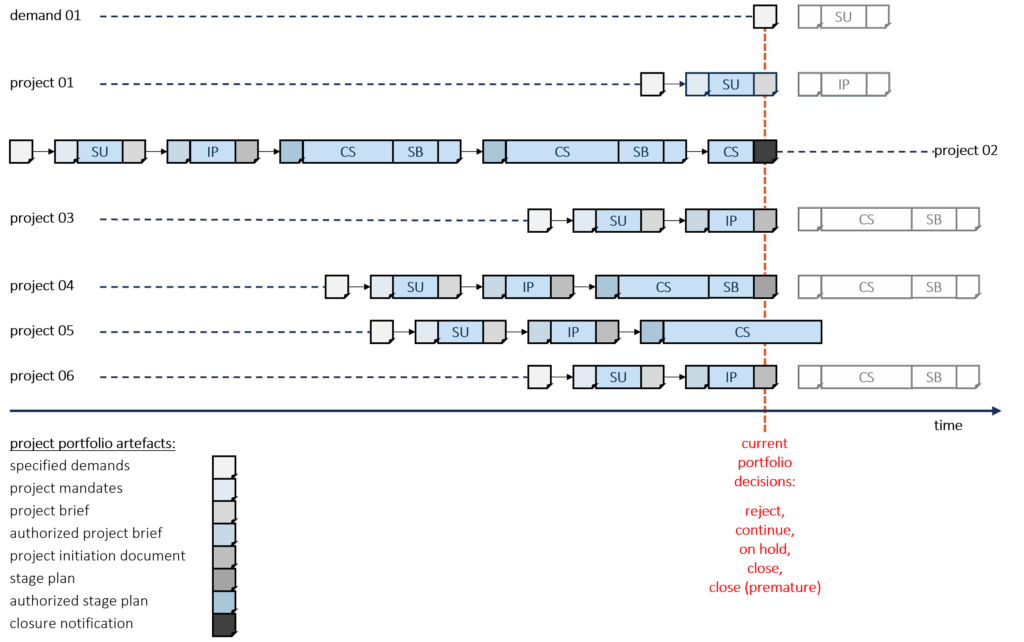
    Introduction Of Project Portfolio Items

    • Specified Demand
    • Project Brief
    • Project Initiation Document
    • Stage Plan (request to release next stage)
    • Reject
    • Approve (= continue with project)
    • Set on hold (= stop project, resume project later)
    • Close regularly
    • Close prematurely

    The decisions are normally taken in the project portfolio board. Among others the decisions are taken based on the following criteria:

    • existing constraints like available budget and available capacity of human resources
    • expected benefits (monetary / nonmonetary)
    • risk evaluation (threads / opportunities)
    • fit to strategic needs

    The Resource Capacity Constraint

    • overburden & multitasking
    • poor quality
    • Delays in project delivery

    Portfolio management need to consider resource constraints when new projects are release (same applies to budget and timeline constraints).

    Resource management needs to be implemented to a suitable maturity level
    0 – nothing
    1 – planning only
    2 – planning & allocation
    3 – planning, allocation, and tracking
    4 – …on cost unit or work package level
    5 – forecasting

    A similar approach can be used to identify budget constraints.

    Interface Project Management & Project Portfolio Management

    • Scope
    • Quality
    • Timeline
    • Resources
    • Cost (Purchases)
    • Benefit
    • Risks / Issues
  • How To Choose The Right Project Setup

    Explore modern IT work organization — particularly project management, operations management, and product development.
    Projects are temporary efforts to deliver unique outcomes. They’re best managed using frameworks like PMBOK or PRINCE2.
    Operations are ongoing, repetitive tasks (e.g., running a service desk or continuous software updates), guided by principles like ITIL and process management frameworks (e.g., COBIT, BPM CBOK, Lean, KANBAN).
    Sometimes, hybrid approaches are most effective—for instance, treating a large migration as a project while executing repetitive parts with operations-style efficiency, e. g. a “migration factory”.
    Product development overlaps both domains. Customer-specific software is typically project-driven, while standard product evolution often uses agile methods like SCRUM.
    The challenge is choosing the right structure: Project, operations, or a hybrid—based on the nature of the task. The text sets the stage to explore decision-making concepts like the Cynefin Framework and Stacey Matrix to guide this choice.

    I belong to the baby boomer generation. Those who were still allowed to drink water from garden hoses, grew up offline, and had to be at home when the streetlights came on. The big bang of the IT universe was already history in 1962, and the IT universe began to expand unnoticed. Today, IT is omnipresent.
    Do you know the Hitchhikers Guide Through Galaxy? The Hitchhiker’s Guide to the Galaxy is a comedy science fiction franchise created by Douglas Adams, 1978. The IT nerds among us already know: In 2025 the Babel Fish (“is small, yellow and leechlike, and probably the oddest thing in the Universe. It feeds on brainwave energy received not from its own carrier but from those around it.”, taken from Hitchhikers Guide through Galaxy by Douglas Adams) which can translate spoken words, is thanks to artificial intelligence, cell phones, and in ear headsets as technology available.
    In our IT universe we live in the management galaxy. Several suns try to outshine each other with their radiance: IT project management, IT process management, IT Service Management, IT operations management. The suns are orbited by several planets: PMBOK, PRINCE2, KANBAN; SCRUM, NEXUS, COBIT, TOGAF, ITIL, … Obviously, there are gravitational forces between the planets.
    You want to setup an IT project? You don’t know if you follow waterfall or agile approach? You are not 100% sure if your planned rollout is a project because a lot of steps consists repeatable tasks? May operations management fit better to a rollout?
    Don’t get lost, continue reading the guide through our management galaxy.

    It merely serves to improve our understanding of practice.

    The Theory:

    It is generally accepted that a project is a temporary effort undertaken to create a unique product, service, or result. It has a clear beginning and end, and it’s usually constrained by time, budget, scope, and resources.

    In contrast operations are ongoing and repetitive (like running a factory or providing customer service).

    Project management and operations management can be considered as two different domains.

    Simple projects can be managed within the line organization.

    For more complex projects you should establish a temporary project organization which manages the project. People working in the project report in their operations role to line manager, and in their project role to the project manager. This setup is known as matrix organization. At the end of the project, the temporary project organization is dissolved. Remaining tasks are handed over to line organization.

    Activities frequently start in the line organization, e. g. the implementation of improvement measures. The team learns and gains better understanding.

    Due to increasing complexity, the line management might be overwhelmed with coordination of project related activities, and a project is initiated.

    The start of the project can be seen as the start of the work in the line organization or the start of setting up the project organization. The “official” start, the date stored in the project management artifacts, is often somewhere in between. It is important that the results of the line organization’s preliminary work are documented and considered as a prerequisite for the project.

    If the remaining work no longer justifies the additional effort involved in project organization, the project organization can be dissolved before the end of the project, and the project can be completed within the line organization.

    The end of a project can be set to shutdown of the temporary project management organization or to the date of completion of the last deliverable.

    An incident tickets operated in a service desk can convert into major incidents and might require a project to resolve the service interruption.

    A mailbox migration, e. g. a migration from a legacy to the future email system or a migration from mailboxes of an acquired company during a merge, would be considered as a project (one time undertaken).

    If we narrow our focus to technical mailbox migration and plan how to migrate 20,000 mailboxes, it makes sense to fall back on tried-and-tested production control methods. Welcome to the domain of operations!

    How would you organize this?

    You can apply a hybrid approach gives you control and efficiency. Treat the overall mailbox migration as a project but design setup a “migration factory” using operations management principles. Design and manage the actual mailbox migration process.

    You can apply a hybrid approach gives you control and efficiency. Treat the overall mailbox migration as a project but design setup a “migration factory” using operations management principles. Design and manage the actual mailbox migration process.

    A new end user device (notebook, operating system, standard applications) needs to be introduced globally. The overall undertaken is a projects, the rollout steps executed country by country / legal entity by legal entity are repeatable.

    A hybrid approach looks promising. The projects delivers blueprints and for a rollout factory and manages the overall progress, upcoming escalations, and general issues. The country organizations implement the factories and execute the rollout on the sites.

    What about IT product design and development, is this a 3rd domain?

    The design and development of IT products is related to the project management and the operations domain.

    Following the classic “waterfall” approach we see a process encompassing requirements specification, solution design, implementation, testing, and deploying.

    For a customer specific software application to be build and delivered in x month project management in combination with product development should be applied.

    In contrast, the development, further development, support, and maintenance of a standard software product normally is not covered by the project management domain. For a standard software product management and product development principles could be applied.

    For the development as such agile approaches like SCRUM are frequently used.

    The introduction of complex standard software (e. g. SAP, ServiceNow, …) at customer sites is usually organized as a project.

    The implementation of updates, upgrades, patches at customer sites streamlined processes are required. Continuous deployment would be good choice. Operations management would apply here.

    The examples mentioned before show that choosing the right organization to manage work to be done is no trivial task.

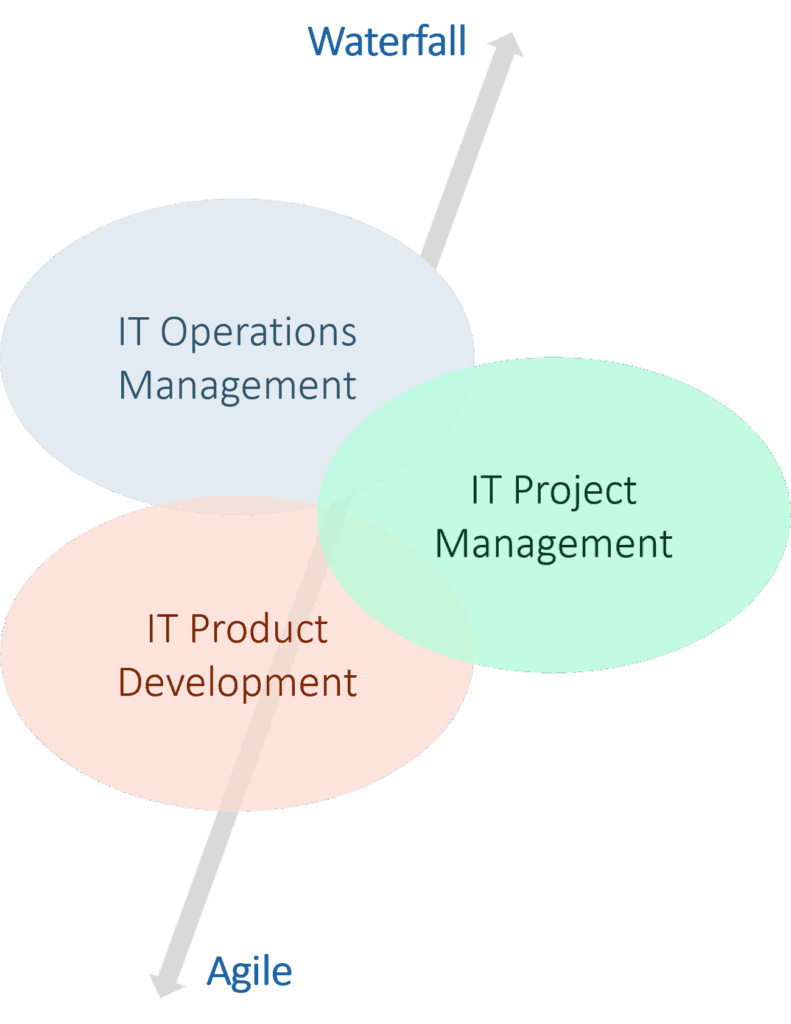
    Project management, Operation Management, and Product Development are overlapping.

    How should you manage the work to be done?

    You can apply the following rules of thump:

    • Apply project management frameworks/methods to manage projects. The PMBOK (Project Management Body Of Knowledge) or PRINCE2 (Projects In Controlled Environments) will guide you.
    • Apply IT operations management frameworks/principles/methods to menage your operation. The ITIL (IT Infrastructure Library) is a good guidance. To optimize operation processes, apply process management frameworks. BPM CBOK (Business Process Management Common Body Of Knowledge, COBIT (Control Objectives for Information Technologies), KANBAN, or Lean Management serve as a starting point.
    • IT Product development is a wide-ranging field with multiple frameworks. It will not be considered further here.

    A second dimension relevant for a setup, is the question if waterfall or agile methods should be applied to organize work. Continue reading to learn how the Cynefin Framework and the Stacey Matrix to choose the right setup.

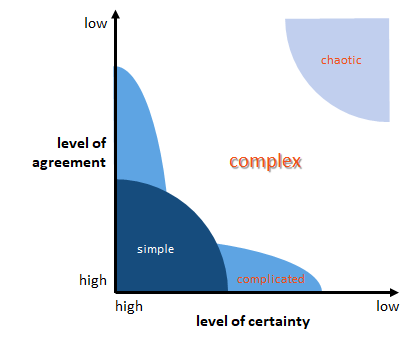
    The Stacey Matrix is a decision-making framework that helps leaders and teams determine the best approach to managing a situation based on two key factors:

    • Level of certainty (how well we understand the problem/solution)
    • Level of agreement (how much people agree on what should be done).

    The matrix has two axes:

    • Horizontal axis: Level of certainty (from high certainty to uncertainty)
    • Vertical axis: Level of agreement (from high agreement to disagreement)

    This creates four general zones:

    • Simple (or Clear) – High certainty, high agreement.
      → Best handled with standard processes or best practices.
    • Complicated – High certainty, lower agreement or specialized knowledge required.
      → Needs expert analysis or multiple good practices
    • Complex – Low certainty, low agreement.
      → Requires experimentation, learning, and agile approaches
    • Chaotic – No clarity or agreement.
      → Immediate action is needed to stabilize the situation before analysis

    The Stacey Matrix is widely used in agile, project management, and organizational leadership to decide:

    • How to approach a problem
    • Whether a traditional or adaptive method is best
    • When to use innovation vs standardization

    The difference between complicated and complex is that complicated is difficult or convoluted while complex is made up of multiple parts.

    From a certain point on, complex problems can no longer be resolved, can no longer be presented, and thus can no longer be understood.

    This must be accepted, just like complexity itself.

    Accordingly, the solution, the chosen approach to the problem must have variables and options, and it must be iterative. Trying, correcting, trying, correcting, … That’s how you learn to deal with complexity. Just like in life.

    Cynefin is a Welsh word meaning habitat, haunt, acquainted, or familiar.

    It was developed by Dave Snowden in 1999 at IBM and published as article “A Leader’s Framework for Decision Making” in the Harvard Business Review by Dave Snowden and Mary E. Bone in 2007.

    The framework offers decision-makers a “sense of place” from which to view their perceptions.

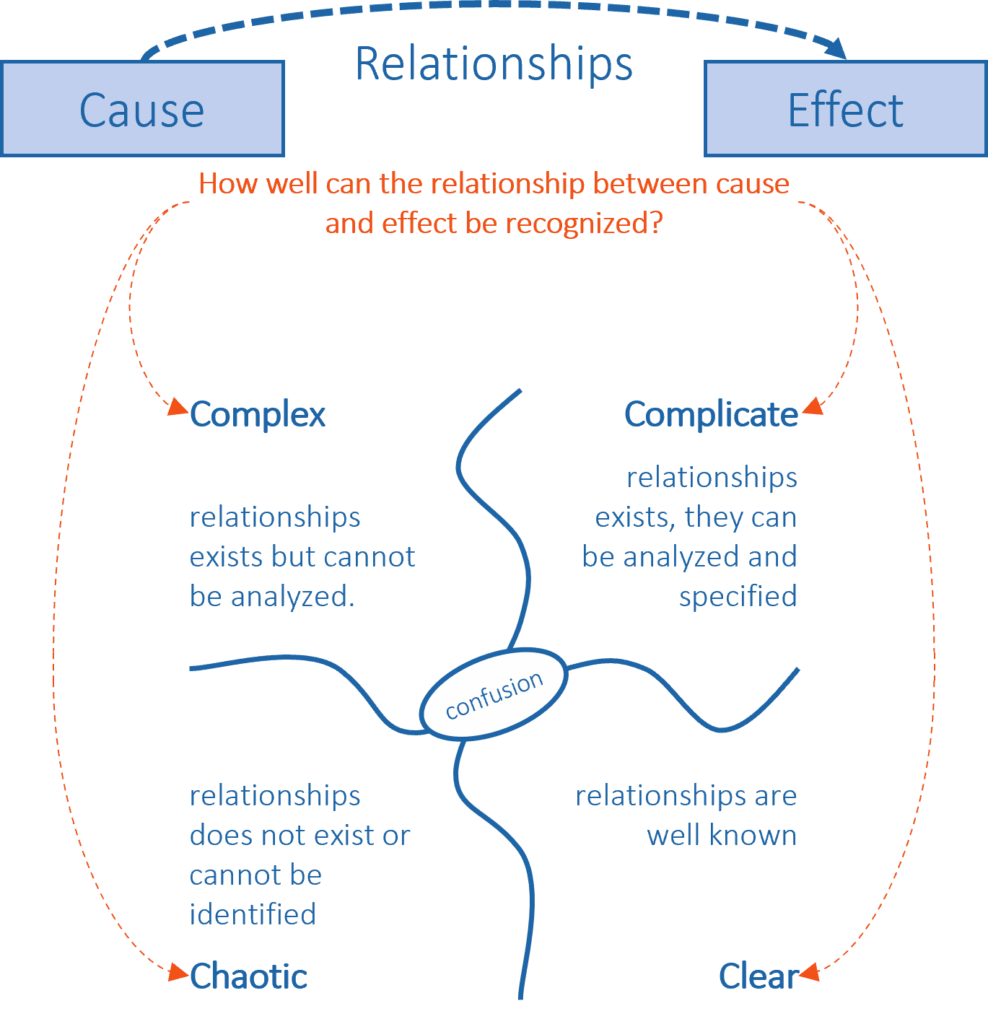
    The framework assumes that there is a relationship between a cause and an impact.

    The analysis of the relationships between causes and effects lead to five domains.

    A recommendation can be made for each domain on how decisions should be made.

    The five domains are:

    • Clear
    • Complicate
    • Complex
    • Chaotic
    • Confusion

    The domain “Clear” represents the known known.

    There are known rules in place which specify the relation between cause and effect: When the sun is shining and it is raining, you can see a rainbow.

    How to make a decision::

    • Sense: establish the facts
    • Categorize the facts and select applicable rules
    • Respond: follow the rules, apply best practice

    This domain encompasses operations. For IT service management most of the companies apply the ITIL (IT infrastructure Library) framework.

    The domain “Complicate” represents the known unknown.

    Relations between cause and effect exist. The must be analyzed to understand them.

    The decision workflow consists of:

    • Sense: assess the facts
    • Analyze the facts (requirements, constraints, solution concepts)
    • Apply an appropriate solution, if possible derived from good practice.

    This domain is the home for technical experts, software developer, and other specialists.

    This domain we find typically IT projects that are handled according to the waterfall approach: Analyzing requirements, developing and implementing solutions.

    The domain “Complex” represents the unknown unknown.

    Relations between cause and effect can only deducted retrospect, “right” answers are not available.

    How to make a decision:

    • Probe: try an experiment
    • Sense: assess the results
    • Respond

    This domain is typical application of agile approaches applied in volatile, uncertain, and ambiguous environments.

    A detailed planning for projects in the domain complex is “muda” (the Japanese word for a pointless activity, the absence of meaning or usefulness). A detailed planning most likely cannot be implemented. A possible reaction is an increase of micromanagement. More control leads in complex environments to more time loss. It is highly inefficient in a dynamic and untransparent environments. Empirical approaches are more appropriate.

    The product development where we often have uncertainty about the final product and uncertainty regarding the solution development is a candidate living in the complex domain Here the application of Scrum is advantageous. From sprint to sprint we learn, we understand relations between cause and effects better. We can adapt to changing requirements by refining the product backlog.

    The domain “Chaotic” is characterized by unpredictability or randomness.

    The decision workflow consists of:

    • Don’t loose time to identify patterns and understand relationships.
    • Establish order. If possible, push the reset button.
    • Move the situation from the domain chaotic to the domain complex.
    • Follow the decision workflow of the domain complex.

    Example: After a major incident, a complex IT system is unavailable. Technical experts analyze log files. Due to existing complexity, the impact of countermeasures like installing of patches, restoring database is unpredictable. The manager on duty decides to reboot all systems to move the situation from the chaos domain to the clear domain. Operators can follow the runbooks for restarts.

    The domain “Confusion” complements the afore mentioned domains.

    It is not clear which of the afore mentioned domains one is in.

    The recommendation here is to carry out a breakdown and assign the resulting sub-situations to one of the other four domains to make decisions there in accordance with the recommended procedures.

    The following table outlines the mayor differences between the Stacey Matrix and the Cynefin Framework:

    CriteriaStacey MatrixCynefin Framework
    Purposeunderstand agreement and certainty in decision makingdetermine how to approach problems based on their nature
    Structureshow matrix based on agreement and certaintyspecify domains based on the known known, known unknown, and unknown unknown
    Use Casesin product development or project management: decide which approach, waterfall or agile, fits bestmore general, in problem solving and decision making

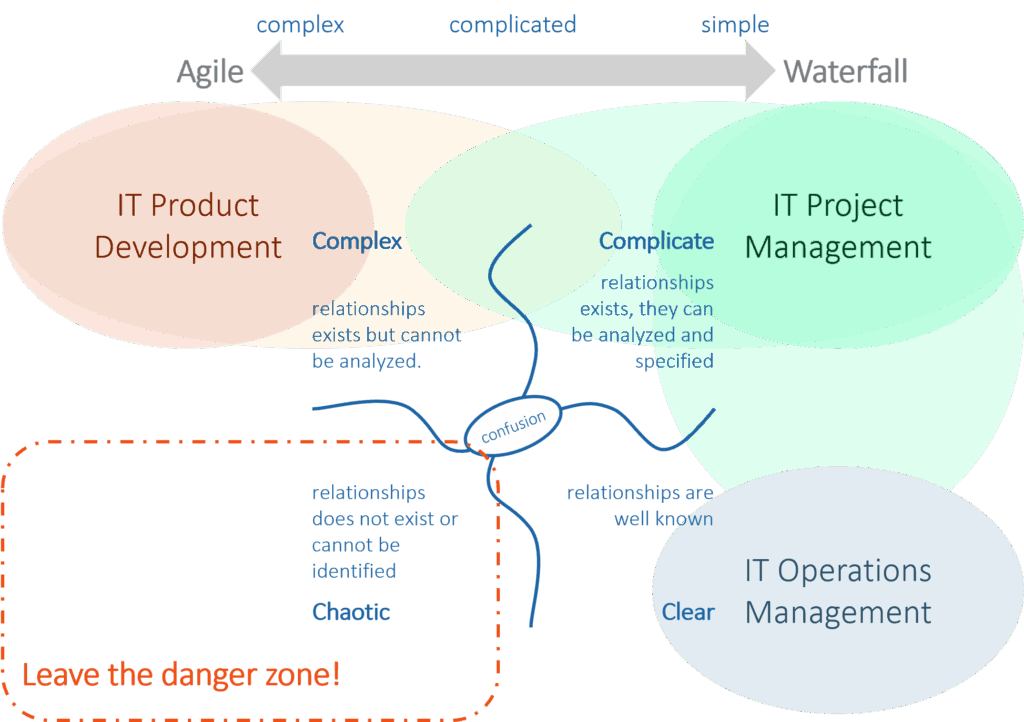
    The map shown on the right visualize which solution approach fits to which domain.

    The clear domain is a candidate to apply operations management:

    • Setup a factory
    • Apply best practice
    • Think in more operations management than in project management
    • Optimize flow by applying KANBAN

    The domain complicate is a candidate to apply project management, most likely applying waterfall approach:

    • Setup and staff a project team
    • Specify a solution phases:
      • Requirements analysis
      • Solution Design
      • Implementation
      • Testing
      • Deployment
      • Handover to operations
      • Hypercare
    • Manage the project
    • Mitigate risk to fail by implementing a prototype
    • Limit project duration, for long running projects changes are more likely which undermine the solution design
    • Continuously check if the project is moving from complicate to the complex domain (Stacey Matrix)
    • Consider a premature project closure and a restart in an agile product development

    The domain complex is a candidate to apply product development, most likely applying agile approach.

    Here…

    • A project organization is not recommended
    • Setup a product development organization, staff required subject matter experts
    • Establish an agile approach to manage the product development

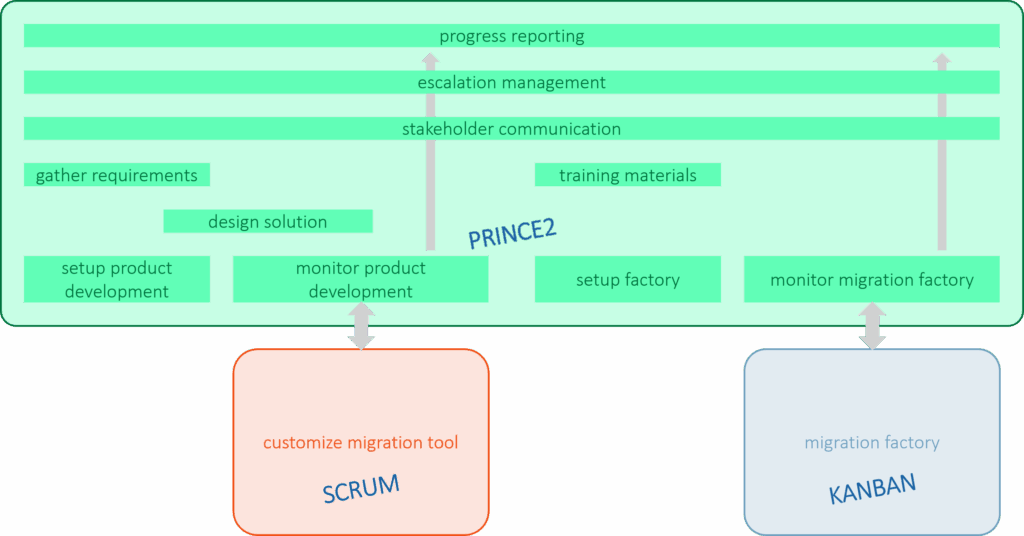
    A legacy SharePoint environment should be migrated to a new platform. A standard migration tool does not cover all business requirements. Some customizations and interfaces need to be implemented. Once the tool is available the migration will migrate SharePoint server country by country.

    Setup a project organization to manage the migration end to end.

    Setup a sub-team which will customize the migration tool, applying SCRUM.

    Setup a migration factory which manages and execute the global rollout. KANBAN will be applied to optimize the migration flow.

    Both factories are interfaced with the overarching project to monitor the progress.