Summary
This article outlines the distinctions and interrelationships between IT operations, IT service management, and IT project management.
While IT operations are ongoing and repetitive, projects are temporary and unique.
IT Service Management (ITSM) operates as a strategic layer over IT operations, often divided into technical operations and user-facing services, and includes functions like Service Catalogue Management.
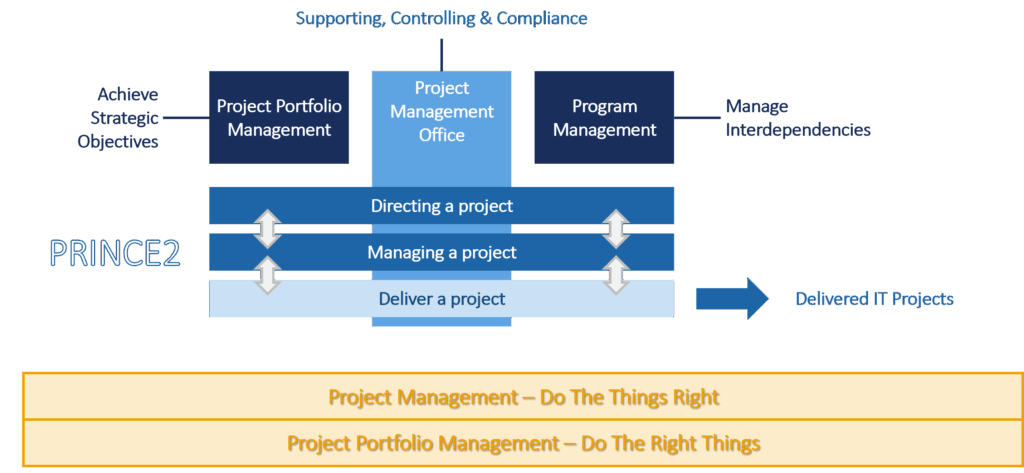
Service Portfolio Management aligns IT services with strategic objectives, like Project Portfolio Management, by evaluating benefits, risks, budgets, and resource requirements.
The traditional Plan–Build–Run paradigm separates project execution from service operations but struggles in complex, agile environments.
Alternatively, the Demand–Supply–Execute paradigm integrates project and service management, recognizing shared resources and the need for adaptive execution. The text emphasizes the blurred lines between incidents, service requests, and projects, noting that both services and projects rely heavily on human resources (80% of spend) and increasingly overlap in execution.
The overall message advocates for integrated, flexible approaches to IT delivery, resource allocation, and value creation.
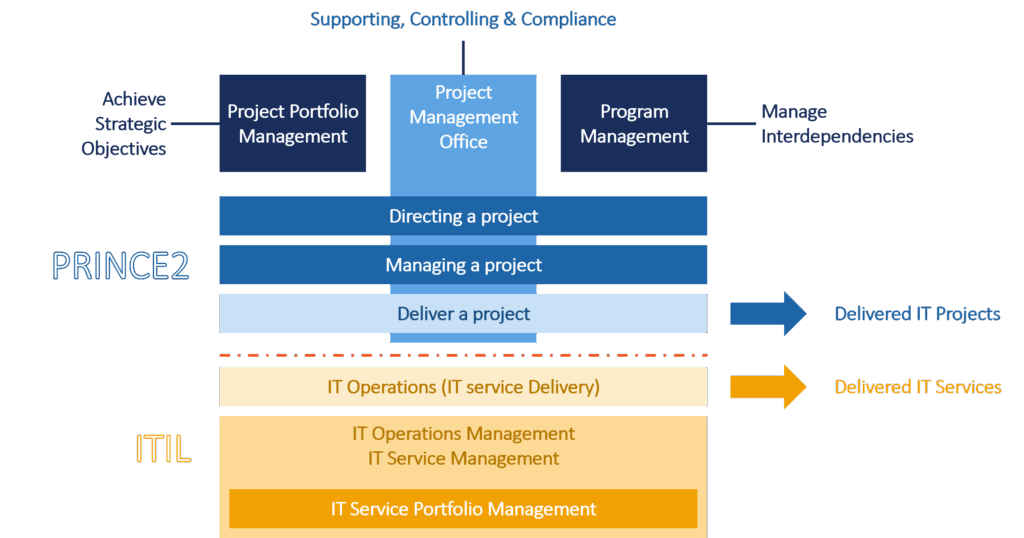
IT Project- & IT Service Management Map
IT Service Delivery / IT Operations
In contrast to projects, IT operations are ongoing and repetitive (like running a factory or providing customer service).
Projects (which are a one-time endeavor) and operations (which are repeatable) can be considered as two different domains.
IT Service management
This is the management layer above the IT operations. Some company split it into technically focused operation management and customer/user orientated service management. IT Service Management includes IT Service Catalogue Management.
IT Service Portfolio Management
The Service Portfolio Management could be seen as a pendant to the Project Portfolio Management. According to the strategic objectives the offered IT services are selected.
IT Project Portfolio Meets IT Service Portfolio
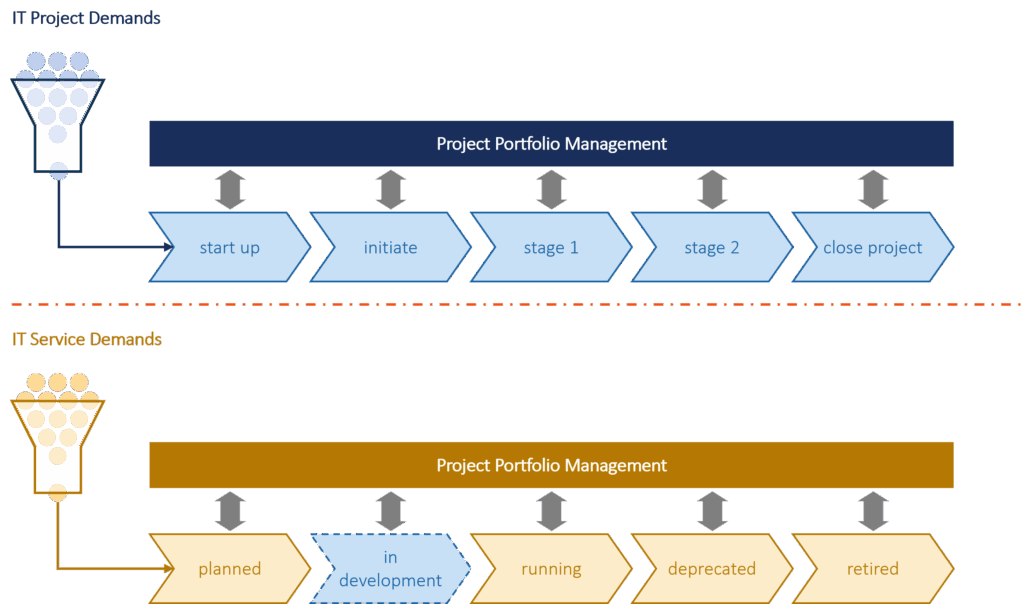
The management and an IT project and an IT service portfolio is very similar.
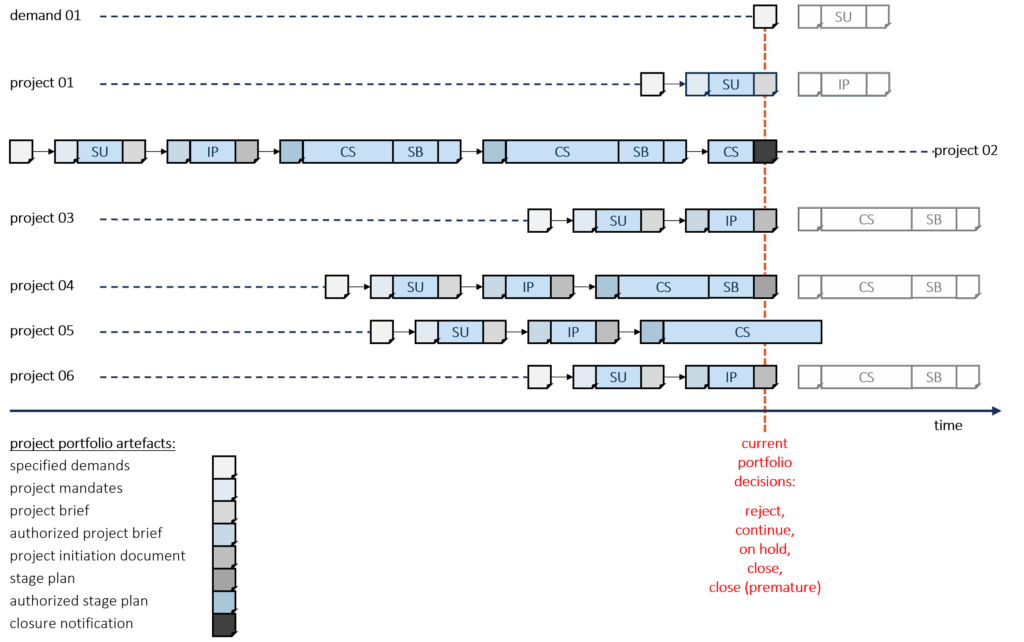
Both deal with portfolio items and decide based on the organization’s strategy which items should be moved to the next stage.
The criteria are, among others
- Expected benefit (monetary & nonmonetary)
- Budget requirements / availability
- Resource requirements / availability
- Risks (threads & opportunities)
- Expected availability date
Resource Constraints Are Impacting Services & Projects
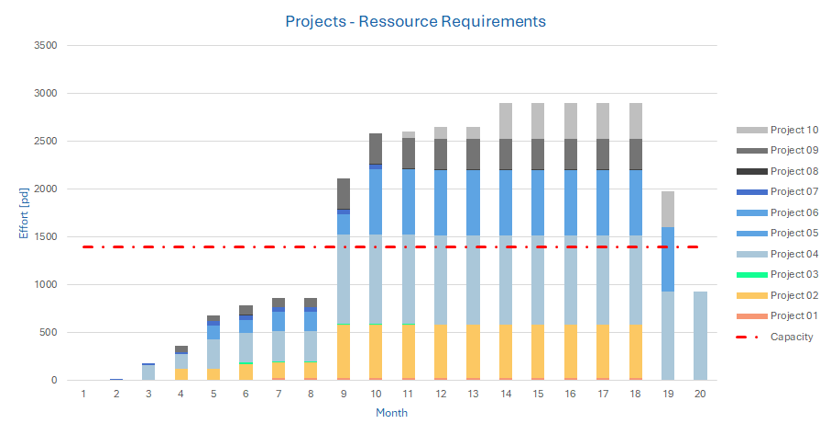
An example of the resource requirements of projects and service delivery is shown above. The orange bars show the resources assigned to service delivery (keep the lights on). The bars above the blue dotted line shows the resource requirements of project.
In month 9 the total required resources exceeds the resource capacity limit.
Resource conflicts lead to
- Overburden & multitasking
- Poor quality
- Significant delays in project delivery
- Breaches of service level agreements
Plan Build Run Vs. Demand Supply Execute
The following content is based on presentation from Charles T. Betz. Unfortunately I do not have the link to the source.
It’s all just work
Incident / Service Request) Tickets become projects and projects become tickets.
A project could impact application- & infrastructure services.
Services could be seen as open ended “projects” for time being.
Services require provisioning which could be handled as a project.
Services and projects compete against the same resources!
Projects deliver output, services transform output into outcome which is visible as delivered IT value.
Distinction between incidents, problems, changes, and user stories become increasingly arbitrary when it is the same team that needs to respond to any.
80% of spend is people.
Plan Build Run

The Plan–Build–Run paradigm separates the world of “projects” (plan & build) from the world of “services” (run). It encourages waterfall thinking. Results in systems are built in isolation from one another. Plan build run works fine for a single system but encounters difficulties in complex service environments with overlapping service-, application-, technology-, and asset life cycles. It is difficult to cope with ongoing improvement, accelerating delivery cycles, agile service delivery processes.
Demand Supply Execute
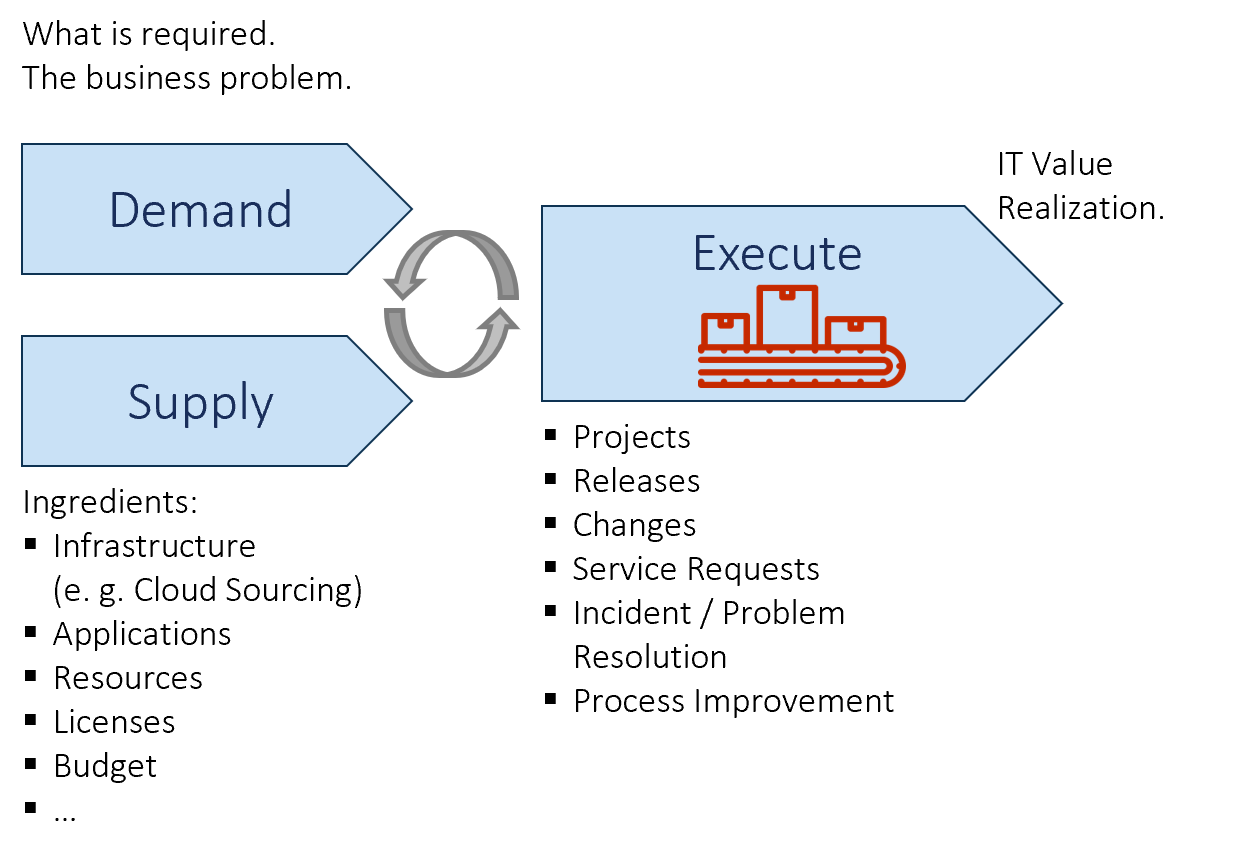
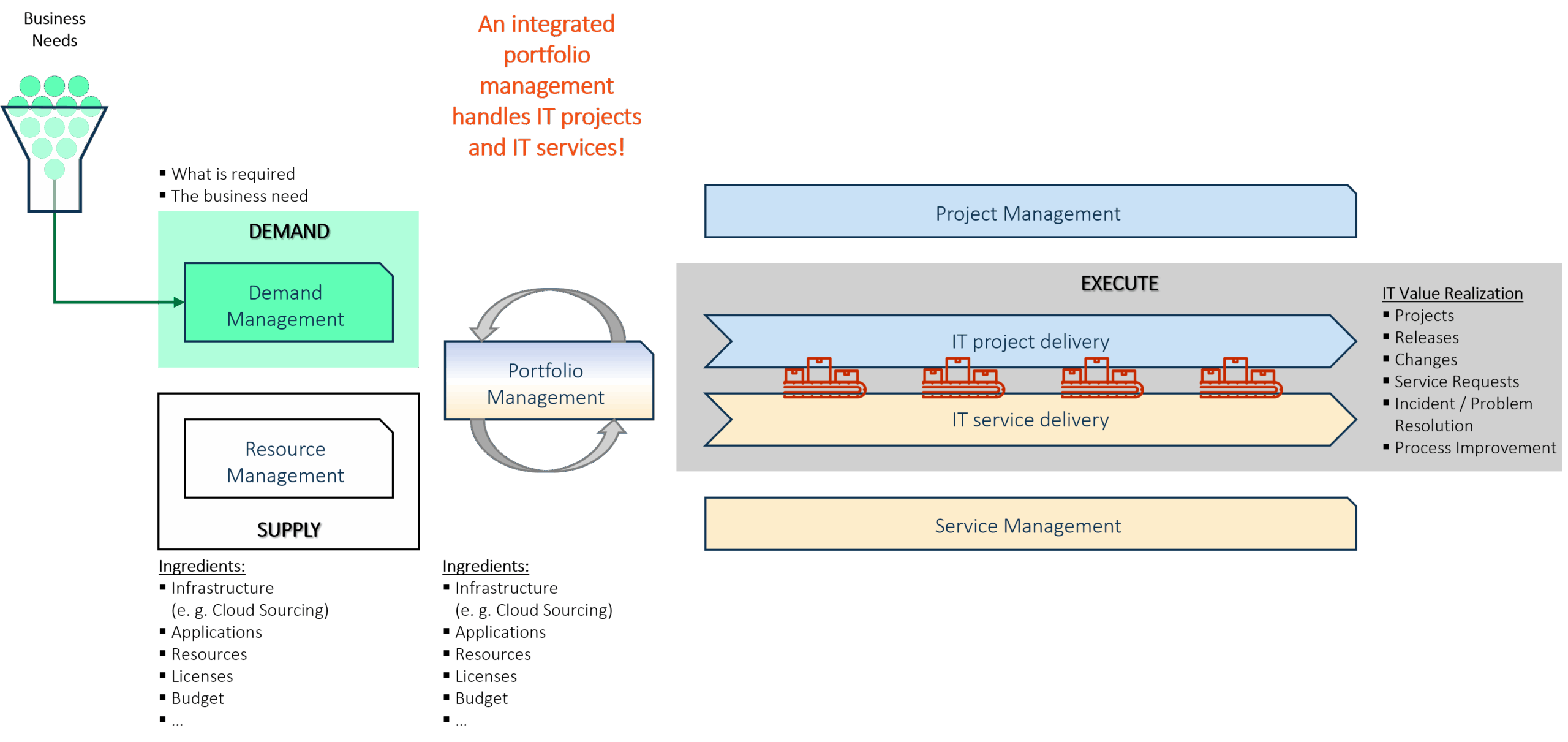
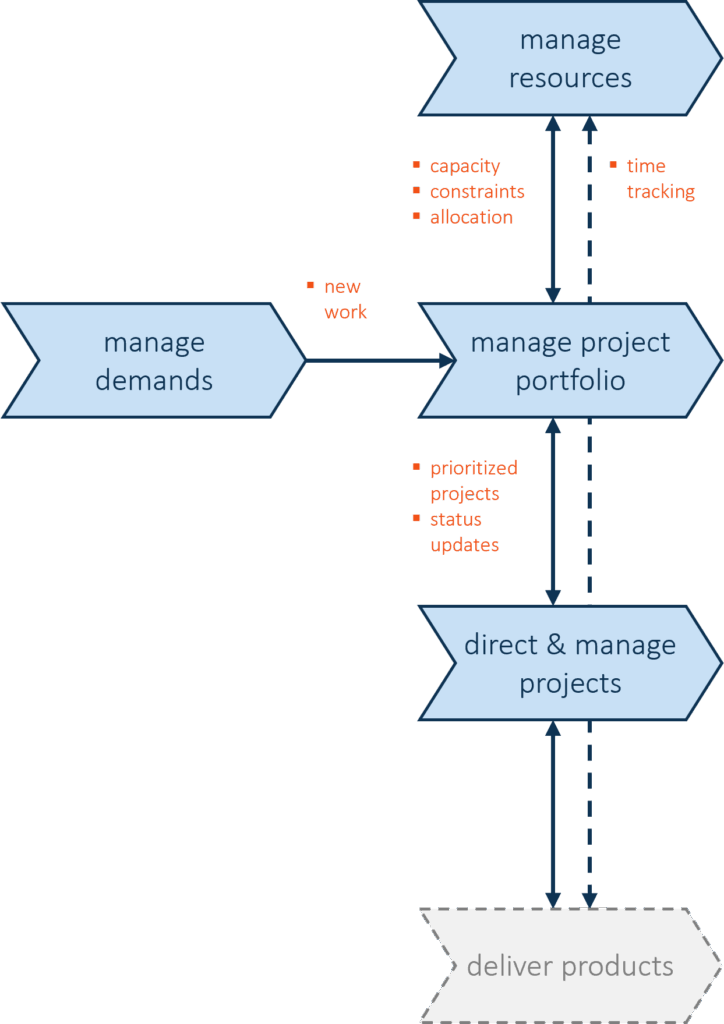
The Demand–Supply–Execute paradigm reconciliates the IT project portfolio items with the IT service portfolio items, both compete for the same resources. It sees time and resource management as a critical success factor. The execute stage supports multiple projects as well as multiple dynamically evolving services.
IT Portfolio Management Based On The Demand Supply Paradigm
The following figure visualizes the concept of an integrated IT portfolio management. Incoming demands are evaluated and will be shifted to execution if they can be “married” with the required supply items (resources, …). IT portfolio management selects valuable items based on known criteria.