
Summary
Organizational units are parts of a company that focus on specific activities, resources, or goals. They are often linked to cost centers and can be visualized in an organizational chart. While business functions describe what an organizational unit does, processes offer a “horizontal” view of interrelated activities to achieve objectives across functions.
Historically, companies were structured hierarchically, with each department working independently. However, this often led to inefficiencies, as improvements in one department could negatively affect others. Michael Porter’s concept of “competitive advantage” (1985) emphasizes that companies gain an edge by offering more value to customers, with key competitive factors being cost, time, quality, and service.
Business process management shifts the focus from optimizing departments to optimizing processes that span multiple departments. It also focuses on the customer’s perspective, asking how a company can gain a competitive advantage by improving business processes.
There is a difference between products and services. Services are intangible, perishable, and must be produced and consumed simultaneously, whereas products can be stocked. Business processes deliver products or services.
A process specification is composed of tasks, activities, roles, business functions, and other components which are described in this article.
Introduction
Organization units are a foundational concept to organize work. An organizational unit is a distinct part of an organization that is responsible for specific activities, resources, or objectives. It specifies how work and people are grouped within the overall structure of the company.
Organization units are often related to cost centers. The vertical break down of an organization into organization units can by visualized by an organization chart.
Business functions describe what an organization unit does, the major capabilities / purposes that support its goals. In contrast, an organizational unit shows who does it and where it sits in the hierarchy.
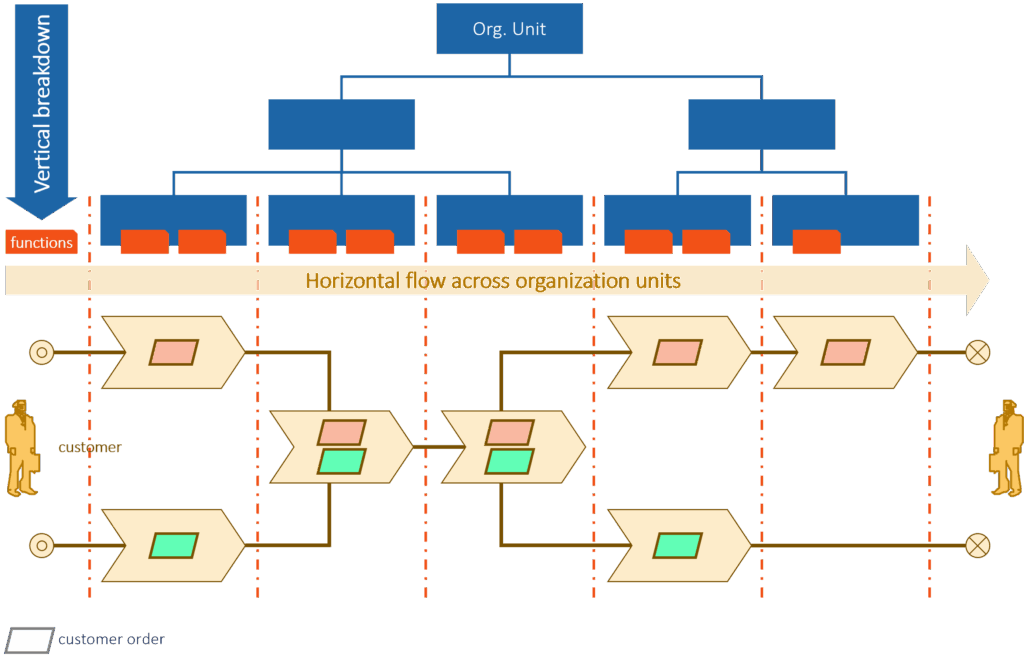
Processes describe a “horizontal” view. A business process is seen as a series of interrelated steps or activities carried out to achieve a specific outcome or objective within or across functions / organization units.
The figure on the below shows schematically the flow of a customer order through an organization.
Let’s have a look to the following Order-2-Cash scenario:
A company sells products to customers. The “order-to-cash” process covers everything from receiving an order to collecting payment.
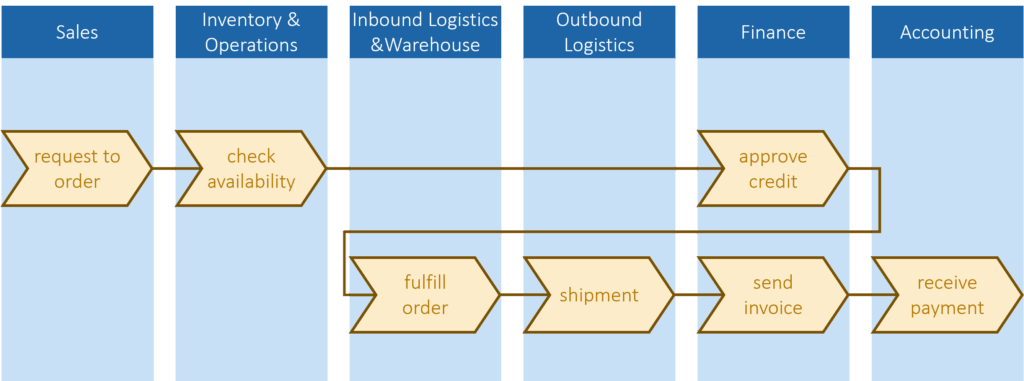
A simplified version of the order to cash process could look like the following:
- The sales department handles the ordering process.
- The operations checks whether the ordered products are available.
- The finance department verifies the customer’s credit before confirming the order.
- The Inbound Logistics &Warehouse department picks the requested products.
- The outbound logistics department conducts the shipment.
- The finance department creates and sends out the invoice.
- The accounting department tracks and books the payment.
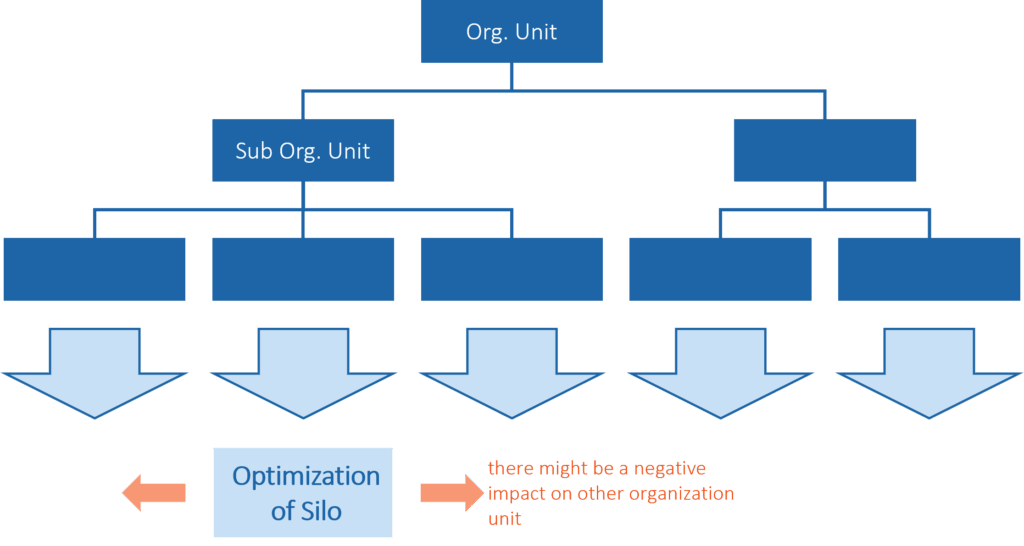
Company structures are often organized in a hierarchy, based on the idea of dividing tasks (applying the principle “division of labor”).
In the past, each department had to operate as independently as possible because sharing information was slow and expensive (like using paper forms or carbon copies).
Each department worked to improve things like efficiency, effectiveness, or quality.
Michael E. Porter defined in 1985 “competitive advantage” as the ability of a company to outperform its competitors by delivering greater value to customers. From the customer’s point of view, competitive advantage essentially means that the company provides something that makes it more attractive or valuable than other options in the market.
Most relevant competitive factors are cost, time, quality, and service.
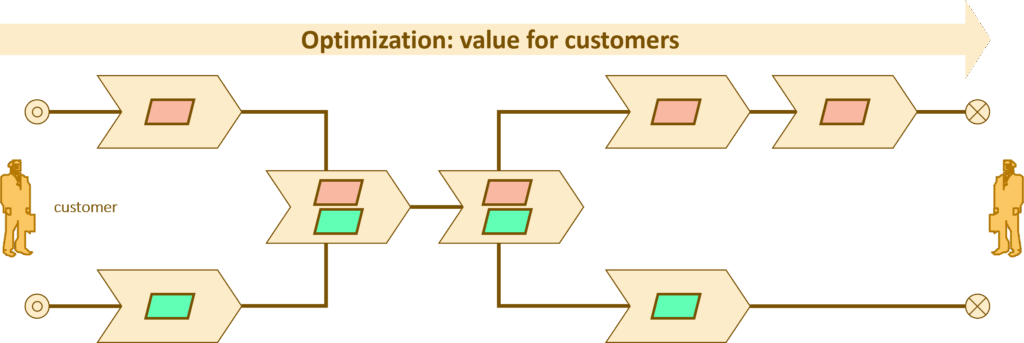
Business process management changes the perspective from the organization unit to the customer. The question is no longer “how can I optimize my organization?”. From a customer point of view we have to ask the question “How can we get a competitive advantage?”. To answer this question we have a look at the business processes which are crossing organization units.
The competitive factors are:
- Price (cost)
- Speed (delivery time, adherence to deadlines)
- Quality Service
- Convenience
- Personalization
- Customer Experience
- Trust
- Sustainability
- Loyalty
- Flexibility, time to market
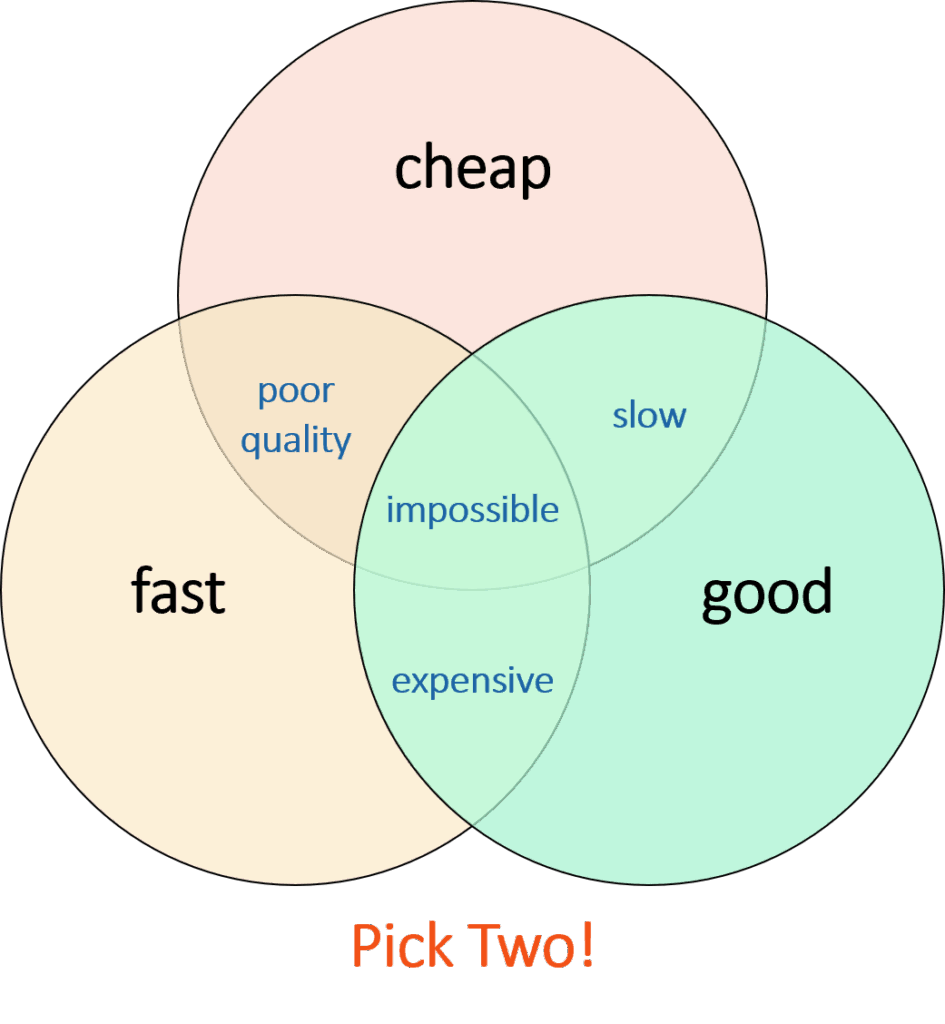
The saying “Good, Fast, Cheap: Pick Two“ refers to the competitive factors price, quality, and time. It means you can’t have all three choices at once.
If you need something good and fast, it won’t be cheap.
If you need it good and cheap, it won’t be fast.
If you need it fast and cheap, it won’t be good.
This is often called the “Iron Triangle” or “Triple Constraint”.
A service is a means to deliver value to customers by facilitating outcomes customers want to achieve without the ownership of specific costs and risks.
In contrast to services, products can be produced on stock.
Services are perishable, intangible, and inseparable, they must be produced and consumed simultaneously. A service is the intangible equivalent of an economic good.
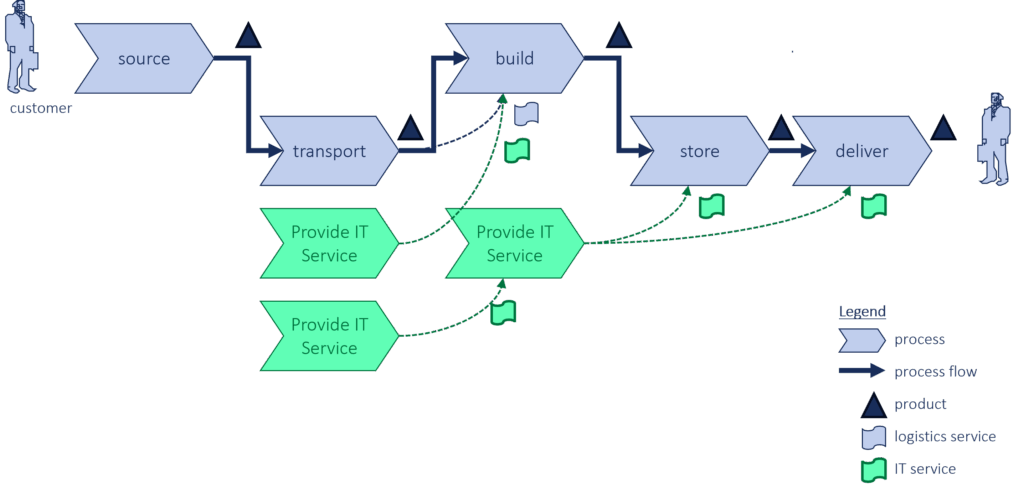
Services are provided by business processes and consumed by other business processes.
A logistics service provider offers logistics services to. An IT service provider offers services related to information technology, e. g. the hosting and operation of a transport control application.
The logistics service provider supports the business processes of customers with logistics services and enhances core logistics services with IT services.
Composition Of A Business Process Specification
Tasks describe the steps or actions taken to perform a specific piece of work.
Tasks represent the lowest level of granularity. There is no further break down of tasks.
Tasks describe the performed work. Different parties may describe performed work in different ways. Normally multiple “correct” descriptions of performed work exist. “Good” descriptions can be differed from “bad” descriptions.
Tasks may be performed manually, may have automated support, or may be totally automated.
The picture below schematically shows a sequence of tasks.

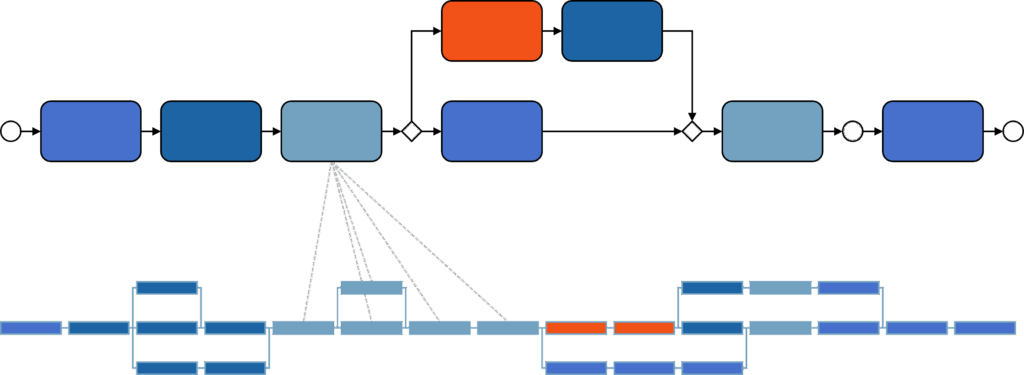
Tasks can be aggregated to activities.
Different parties may aggregate tasks to activities in different ways to describe performed work.
Multiple “correct” aggregation of tasks may exist! Activities are more abstract. They “hide” details provided by a description on task level.
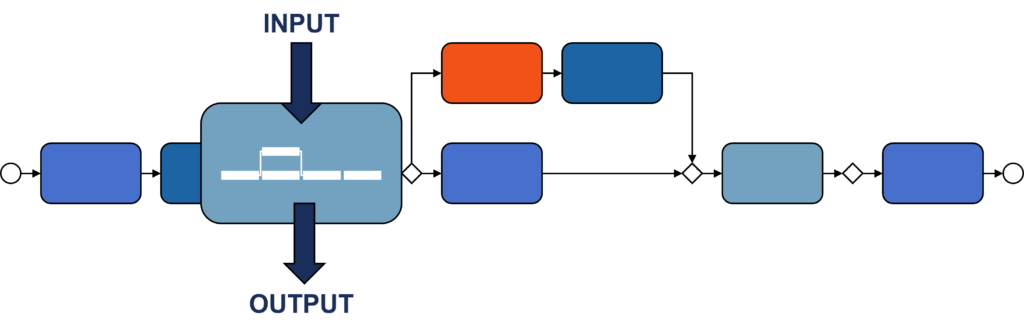
In contrast to tasks, activities normally consume an input to deliver an output.
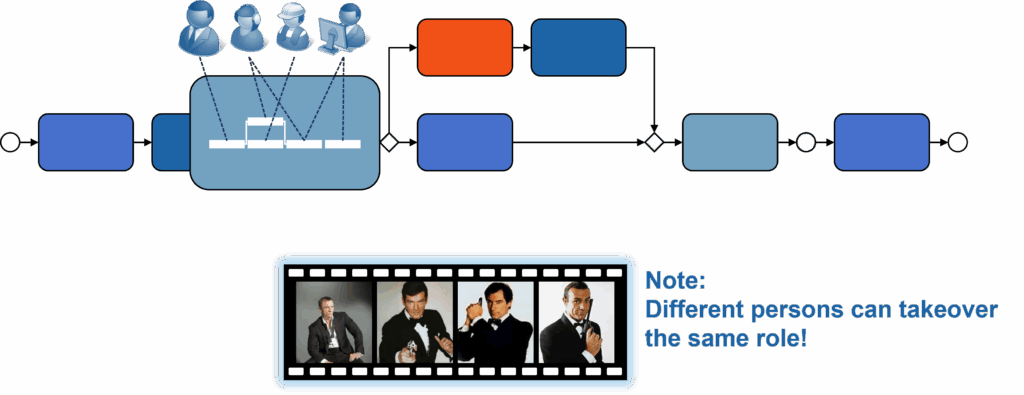
The tasks of an activity are executed by persons.
Each person has certain responsibilities and a required set of skills and competences to fulfill the tasks.
Responsibilities, skills and competences are described by roles. Roles establish a link between persons and activities.
A sequence of activities that transform one or more inputs into a specific output can be aggregated to a process.
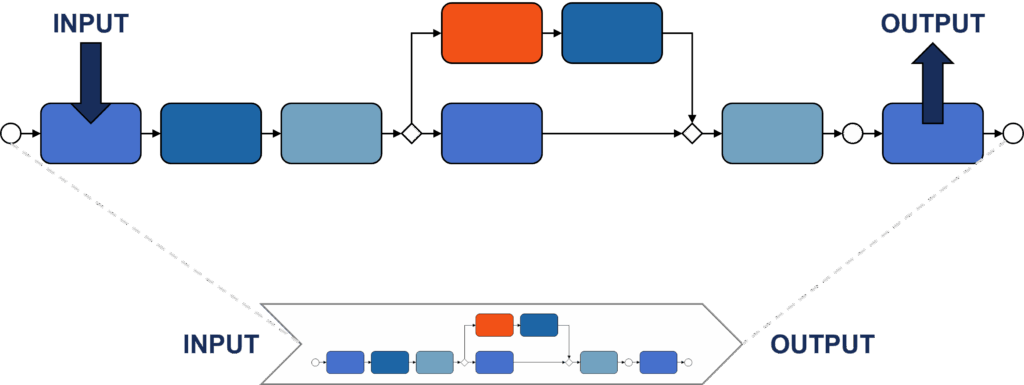
Like tasks and activities, different parties may aggregate activities to processes in different ways to describe performed work.
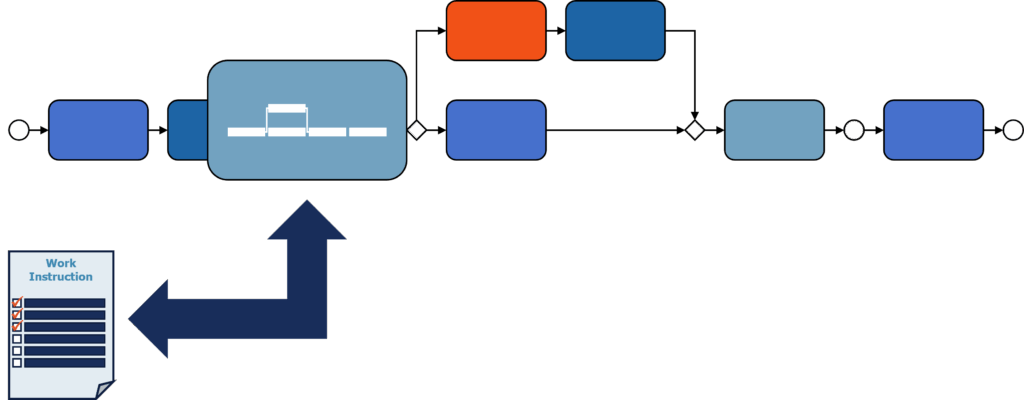
A work instruction describes how an activity is performed. A work instruction can encompass a sequence flow of the tasks to be executed or any technical information required for understanding.
A RACI matrix (also called a Responsibility Assignment Matrix) is a simple method to clarify roles and responsibilities for tasks applied in a business process.
The matrix shows in the rows the activities and in the columns the roles. For each task / role the one of the letters R, A, C I is assigned..
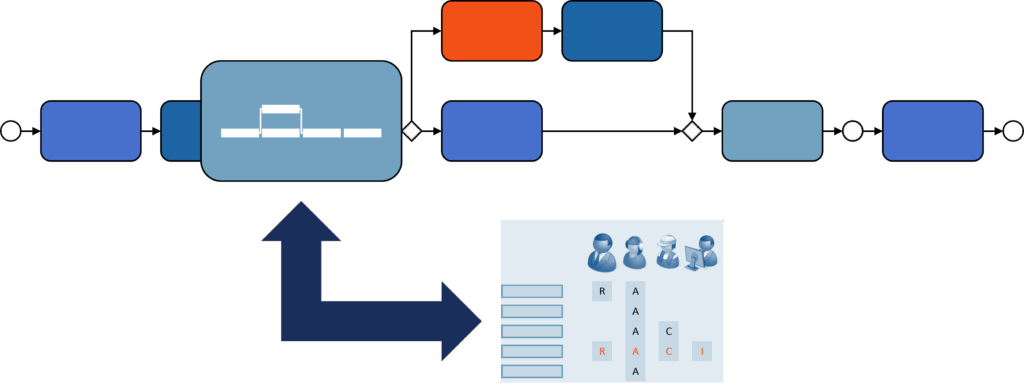
A – The person who is ultimately answerable for the correct completion of the task. They approve the work and ensure it meets requirements. Each task should have only one Accountable person.
C – People who provide input, expertise, or feedback before the work is done. These are usually subject matter experts.
I – People who are kept up to date on progress or decisions but are not directly involved in the task.
R – The person(s) who actually do the work to complete the task. They are responsible for action and implementation.
The workflow or sequence flow represents the sequence in which different events, activities, and further elements are traversed.
When a process is carried out, it uses/creates input/output like data, information, files, documents, etc. A sequence flow from one activity to another is often accompanied by data flow.
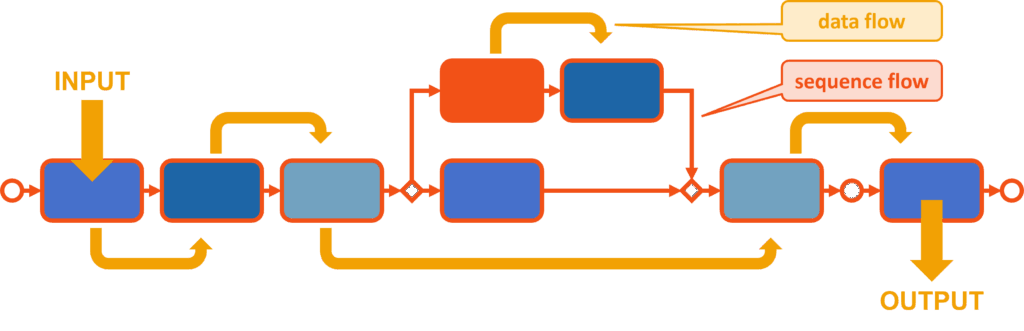
Sequence flow and data flow are two different flows. Don‘t mix them up! It is not possible that a sequence flow becomes a data flow, or a data flow becomes a sequence flow.
The division of labor is the separation of tasks in any economic system so that participants may specialize. Individuals, organizations, and nations are endowed with or acquire specialized capabilities and either form combinations or trade to take advantage of the capabilities of others in addition to their own.”
(taken from https://en.wikipedia.org/wiki/Division_of_labour, November 2016)
Activities can be grouped by applying the principle of „division of labor“.
Groups represent business functions which can be mapped to organizational units.
Ideally a business function is provided by one organizational units, but in practice we see also multiple organizational units providing the same business function.
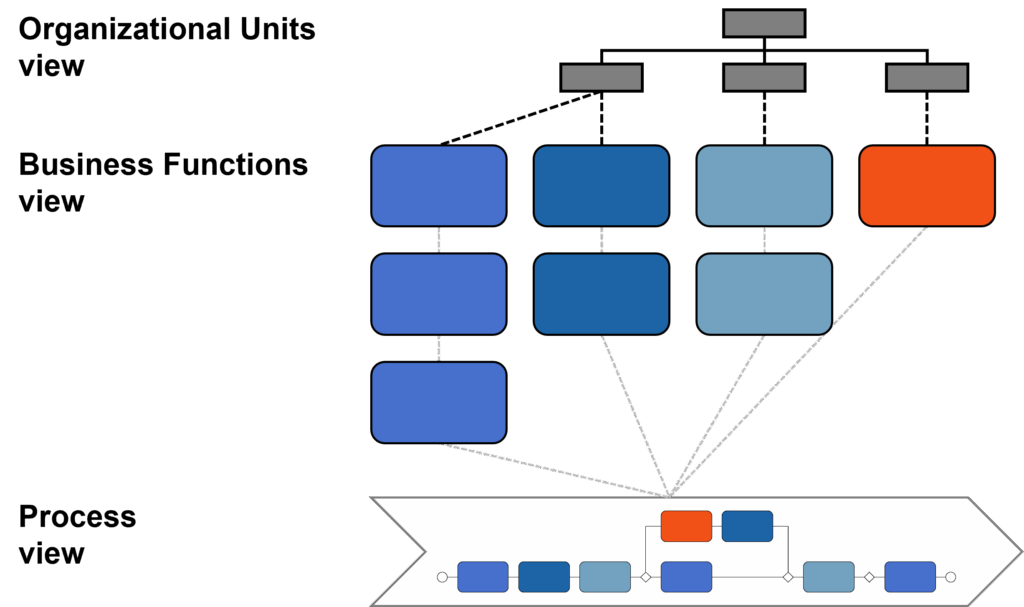
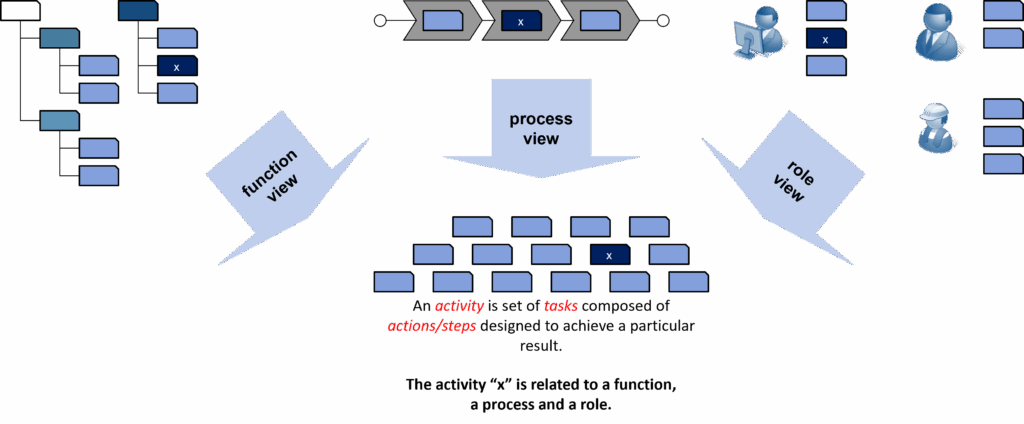
The diagram below illustrates the different views on activities.
- A function is a team or group of people and the tools they use to carry out one or more processes or activities.
- A process is a structured set of activities designed to accomplish a specific objective. A process takes one or more defined inputs and turns them into defined outputs.
- A role is a set of responsibilities, activities and authorities granted to a person or team.
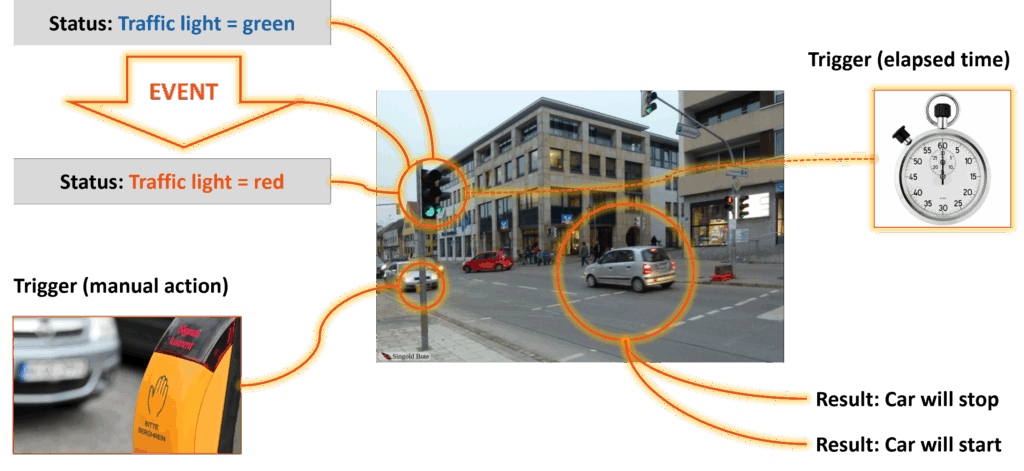
A state captures relevant aspects of a a process. It represents the status of an object. E. g. the status of a traffic light could be red, amber, green.
An event occurs at a particular instant in time and marks a change of. In the traffic light example an event occurs when the status of a traffic light changes from green to amber.
For a fire arm, the trigger is a mechanism that actuates the firing sequence.
In a more common context a trigger may also start another.
In our traffic light example the event “traffic light changed” can be triggered by pushing a button or, time driven by a clock, when a certain amount of time is elapsed.
The result is the consequence of an event.
Trigger and start/finish events will be specified in a process description.
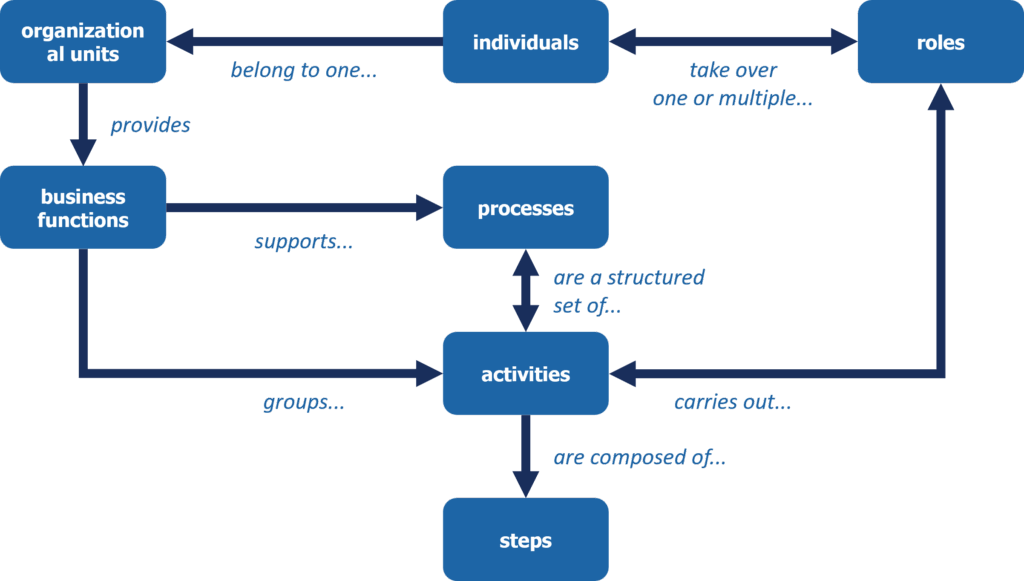
The entity relationship diagram below shows, how the different elements of a business process descriptions belong together.
A state captures relevant aspects of a a process. It represents the status of an object. E. g. the status of a traffic light could be red, amber, green.
An event occurs at a particular instant in time and marks a change of. In the traffic light example an event occurs when the status of a traffic light changes from green to amber.
For a fire arm, the trigger is a mechanism that actuates the firing sequence.
In a more common context a trigger may also start another.
In our traffic light example the event “traffic light changed” can be triggered by pushing a button or, time driven by a clock, when a certain amount of time is elapsed.
The result is the consequence of an event.
Trigger and start/finish events will be specified in a process description.
A process is more than a structured set of activities. A process specification encompasses, beside a workflow diagram, other elements.
The following figure illustrates the composition of a business process specification:
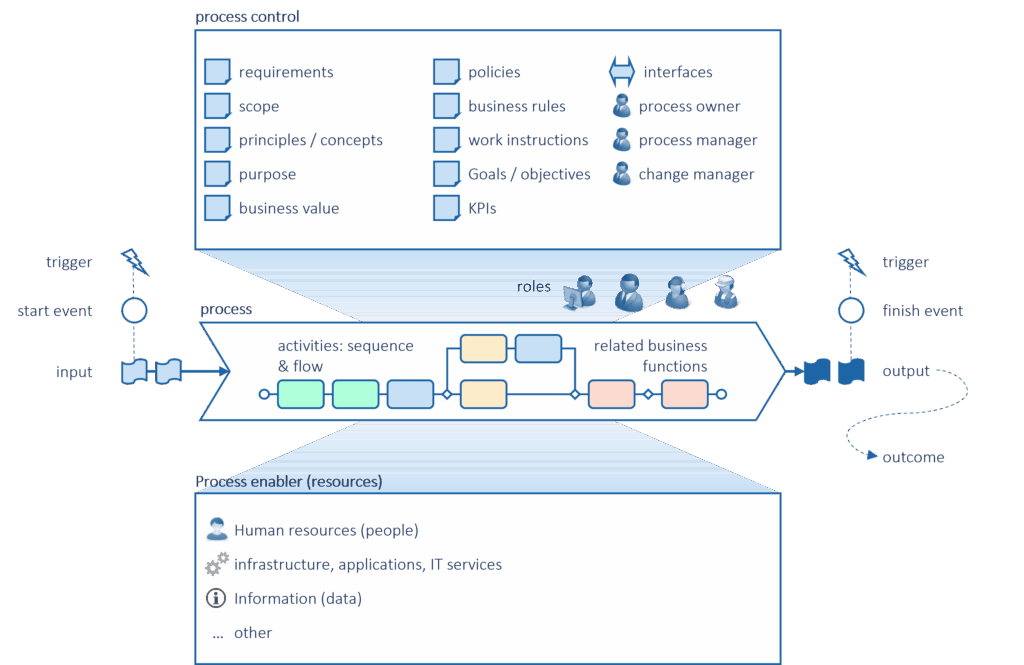
The requirements specification describes the conditions that must be met for the process to function properly — essentially, what the process must be able to do:
- Functional requirements: what the process or system should do (e.g., “automatically send confirmation emails to customers”).
- Non-functional requirements: quality or performance criteria (e.g., “confirmation emails must be sent within 5 minutes”).
- Regulatory or compliance requirements, if applicable.
- Data or resource requirements, such as what information or tools are needed.
The scope statement is a description of the boundaries of the process — what is included and what is excluded:
- The start and end points of the process.
- The key activities, inputs, and outputs.
- The departments, systems, or roles involved.
- Any limitations, exclusions, or interfaces with other processes.
The principles & concepts document the general ideas behind the business process.
The purpose specification is a clear statement explaining why this process exists and what it aims to achieve.
- The reason for developing or improving the process.
- The main objectives or goals (e.g., efficiency, compliance, customer satisfaction).
- How it aligns with the organization’s strategy or vision.
- Who benefits from the process (e.g., departments, customers, partners).
The business value description points out the benefits or value the process delivers to the business — the “why it matters”:
- Tangible benefits (e.g., cost savings, faster processing time, error reduction).
- Intangible benefits (e.g., better customer satisfaction, improved compliance, stronger reputation).
- Key performance indicators (KPIs) or metrics to measure success.
- Expected ROI or strategic impact.
Policies, business rules, and work instructions are key parts of a business process specification. They each describe a different level of detail and control within a process.
Policies are high-level principles or guidelines that set the direction or framework for decision-making within the process. Policies are typically broad and stable — they tell you what must or must not be done and why, but not how.
Business rules are specific. They describe detailed conditions or constraints that govern how the process operates within the policy framework. Business rules translate policies into actionable logic that can be applied or automated.
Work instructions specify step-by-step procedures or instructions that describe exactly how to perform a task within the process. They are the most detailed level — meant for the people actually performing the work.
The business process interface specification defines the relationships to other business processes. Output of one process could be input of another process.
The roles process owner, process manager, and change manager are key governance roles in a business process specification. Each has distinct responsibilities and a specific relationship to the process.
The process owner is the strategic leader of the process. He is accountable for its overall design, performance, and alignment with business goals. Any changes to the process specification, design, and implementation are supervised by the process owner.
The process manager is the operational leader responsible for the day-to-day management and continuous improvement of the process. While the process owner defines what the process should achieve, the process manager ensures how it runs smoothly.
The change manager has a governance and transition role. He is responsible for managing changes to the process — ensuring they are assessed, approved, implemented, and communicated in a controlled way.